Sunday, 15 November 2020

Back to Bill Mays in Kaleidoscope (1992)


Peter Sprague who appeared earlier in the preceding posts reappears, but not Magnusson, at least on this occasion.  And this occasion is surprisingly good for the late year, though marred unfortunately by those dumb standards incl. the horrendously Yersenia Pestis-like Body and Soul which is given a kind of ethereal touch with classical-influenced high-pitch piano key wanderings, interesting to hear though ultimately when that stupid melody kicks in, disappointing.

However there are two tracks here that blew me away, the ST Kaleidoscope:


and the one called Adirondack with the subtitle Wedding Serenade:


These two tracks are absolutely perfect music, as far as I'm concerned, or IMHO as my kids would put it.  There is nothing that could make these better, artistically.

I threw in here a mostly acoustic and mostly solo Peter Sprague release from 1980 I thought would be interesting, but isn't really, called Bird Raga.  There is another from him with the lovely title of Na Pali Coast, a name which will be familiar to those who have ever visited Hawai'i, but there is a track missing and the names have been mixed up, I threw it in too.


If he's reading this, my guitar-loving reader who lives in Hawai'i will surely jump up off his chair. Or surfboard.
Lucky those who are 'locked down' in a beach town!

Friday, 13 November 2020

Howard Roberts Quartet with Bill Mays in 1981's Turning to Spring


If only, we were turning to spring...  More like turning to the dead of winter.  Or turning to the rolling over in the grave.  Or turning into zombies.  Turning to the makeshift morgues...

For a big change in mood for these very dark times here's another pretty and laid-back jazz album that is almost identical to the predecessor post featuring again the keyboardist Bill Mays that will bring you back, I guarantee you, to a time long before pandemic viruses.  Bill's compositional contributions are the highlight here. Note the delicate expressiveness achieved on the electric keys + guitar interplay on No Hurry:


On the database page you can see the credits for songwriting are all over the place, luckily there's only one throwaway jazz standard in Hoagy Carmichael's hoary old Skylark who I'd love to shoot out of the sky with a skeet rifle in mid-song.

Most likely the name Howard Roberts is well known (ha ha ha!) among the true progressive cognoscenti because in the first half of the 70s he put out two tremendously inventive and creative progressive fusion albums in Antelope Freeway (1971) and Equinox Express Elevator (1975) and I hope everyone knows and has those already.  So far as I know that pair were the only masterpieces, and I see tons and tons of dross in his long, long discography. 

More from Bill Mays shortly.

Wednesday, 11 November 2020

Bob Magnusson Quartet, Bill Mays, Bob Shanks, Road Work Ahead (1981)


Here's a lovely little totally unknown release by a bunch of artists I never heard before. Leader Bob Magnusson from NYC plays bass in this group while his quartet adds Peter Sprague on guitar, Jim Plank on percussion, & Bill Mays on keyboards.  Like so many other jazz records a blurb appears on the back with elaborate and fawning descriptions of the music, amusing to read, since it hails from a bygone, pre-social-media era when you didn't have to be cynical, adolescent, and conspiracy-minded to stand up and speak to the world.  So for ex. the track called As Our Children Sleep sure enough was written by Bob for his kids and the title suggested by them (-and wouldn't it be interesting to see the kinds of comments this would pick up in a place like twitter or even youtube if I reprinted that description):


The track called Zephyr by Bill Mays demonstrates a lot of creative ideas:


I'll surely be back with more from these guys.  I threw in a lossless for once because it's so lovely to hear the near mint condition of the record and crystal clear sound-- for all those out there with big-ass speakers still sitting in their living rooms to be used here, I salute you.

Monday, 9 November 2020

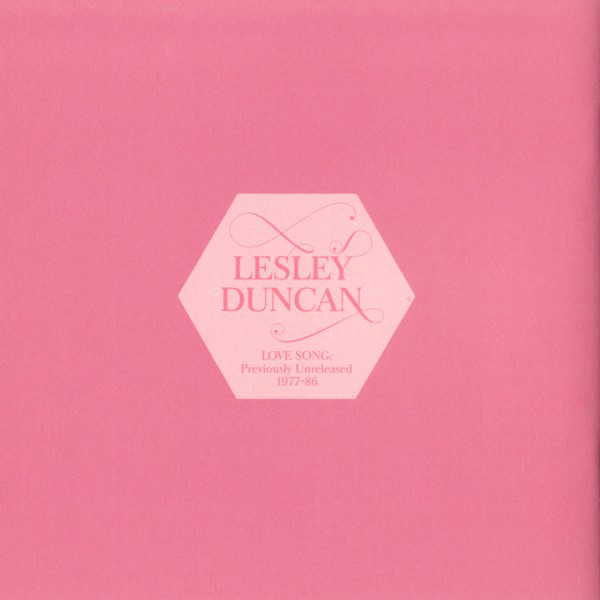
Lesley Duncan Rare and Unreleased, 1977 to 1986 [limited time only]


Information can be found here.
I noticed this when I assembled together the other seventies albums she made, which I so hugely loved, surprised too that I had never come across the artist before, especially since I knew the Love Song track from childhood (which reappears on this cd in a different version).
Unfortunately this did not blow me out of the water, but it has some really nice soft touches here and there.  It makes sense since it comprises leftovers from the wonderful official releases, beginning in the late seventies.  Worth it, for completion's sake.  

Note the last song called Tomorrow which really grew on me, despite the relatively trite theme done so many times in this naive and heartfully sincere period in time now so completely lost thanks to social media with its dumbass adolescent comments and stupid memes:


There are some tracks that pander to that awful 80s style but luckily not many, incl. an 80s version of Bob Dylan's Masters of War tune.  Quite surprising to hear that one.

I can't justify posting more than a limited time only. Look at the beautiful photograph that they placed inside the CD booklet!


Saturday, 7 November 2020

3 from Valerie Carter (Howdy Moon 1974, Just a Stone's Throw 1977, Wild Child 1978)


Truly a beautiful woman.  A natural beauty, incredible to look at.  
Especially with that so retro pouty-lips look on the Wild Child cover, so typical of the times.

Valerie Carter [Valerie Gail Zakian Carter] is an American singer-songwriter. Carter is perhaps best known as a back-up vocalist who has recorded and performed with a number of singers including Jackson Browne, Don Henley, Linda Ronstadt, Christopher Cross and, most notably, James Taylor.
Carter has written songs for Judy Collins ("Cook with Honey" from Collins' 1973 album True Stories and Other Dreams), Jackson Browne ("Love Needs a Heart" from his 1977 album Running on Empty) and "Turn It into Something Good" (from Earth, Wind & Fire's 1980 album Faces) to name but three.
She has recorded six albums of her own and was purportedly the inspiration for the Jackson Browne song "That Girl Could Sing."

[Note that in the seventies there were only 2 releases 'of her own', the other 4 came later.]
Of note too is the fact that the James Newton Howard I featured recently is arranger of the second.

The music here is standard-issue female singer songwriter with not just folky influences along the lines of the earlier Lesley Duncan post but the all-important Joni Mitchell influence-- such a huge, huge part of the decade for female artists.  Not to deny her brilliance, I've mentioned before multiple times I love Joni's music to death and she wrote some of my all-time favourite songs like For Free, Jericho, and the oddly co-opted by the Xmas season, River, from the Blue album.  And I've also drawn attention to the fact she put out an amazing long progressive track called Paprika Plains on the otherwise blah and bland Don Juan LP.  Anyways, this post is not about Joni.  Consider Heartache, from the 1977 album:


(It's amazing how much this foreshadows that 'Lilith Fair' female alternative ssw style that became so so huge in the nineties with artists like Sarah McLachlan.)

The Joni influence is obvious on Back to Blue Some More, which, not said to detract, is quite an intelligently composed song, with its permutations in the chords for the middle section:


The title track for Wild Child is pure melancholy magic:


The feeling is just heartbreaking.
I was amused to hear Allee Willis' wonderful composition The Blue Side (from that double-LP demo set that I loved so much and so few people noticed) appears here.

Her wiki entry is unusually exhaustive.  It begins:

She recorded the eponymous Howdy Moon as a member of folk group Howdy Moon in 1974.
She later left the group to release her first solo album, Just a Stone's Throw Away, in 1977, under ARC/Columbia. Just a Stone's Throw Away featured guest appearances from artists such as Maurice White, Lowell George, Bill Payne, Linda Ronstadt, Jackson Browne and Deniece Williams.
In 1979 Carter went on to release her second album Wild Child, again under the ARC/Columbia imprint. Wild Child was produced by James Newton Howard.

In 1996, Carter returned with The Way It Is, in which she covered songs by Neil Young, Jackson Browne, Van Morrison and Warren Zevon.

Continuing, curiously:

Personal Life:
In August and October 2009, Carter was arrested in St. Petersburg, Florida, for possession of drugs. She successfully completed all of the court's requirements, and she became a graduate of Judge Dee Anna Farnell's drug court program on May 25, 2011. American singer-songwriter James Taylor appeared at her drug court graduation ceremonies in a congratulatory effort on behalf of all of the graduates.  

It Ends:

Carter died of a heart attack on March 4, 2017, at the age of 64. She is survived by her mother, Dorothy "Dot" Carter, and sister, Jan Carter, who continues the Official Valerie Carter Fan Club as an active Facebook group.

I threw in the Howdy Moon record too, it's very charmingly simple.  
Has nice moments, purely folk rock/ssw/soft rock. It's too bad the guys didn't allow her more songwriting opportunity, as her 3 tracks really stand out.
Valerie's backup vocals are noticeable for their exquisite girlishness (and high pitch) and beautifully done vibratos.


Wow, what a lovely group of long hairs!  
Gotta love the expressions on their faces-- how did they do that??  Or rather, with what drug, as my wife would say.

The lovely Cook with Honey song mentioned above showcases that formidable voice: