Thursday, 5 November 2020

US Gypsy and related from 1970 to 1979


Here's another band I was unfamiliar with until recently, though it's not all-out progressive, there are touches here and there, particularly as you move forward in the decade (oddly enough). They are similar to the similarly named Austrian Gipsy Love band which had Peter Wolf in it that I posted here.  Actually they are similar to any number of accessible, radio-friendly, blues-rock-based 'rock bands' from the early 70s with quite a few original ideas or thoughts and not the greatest skill at songwriting, really.  But they did put out 4 LPs in the first half of the seventies.


1970s American progressive rock band from Minnesota, keyboardist James Walsh continued the band in various incarnations as The James Walsh Gypsy Band and Calvin James.

I take it the main songwriter in the early albums was guitarist Enrico Rosenbaum.  The majority of those early songs are hard rock blues with wonderful harmony vocals, similar to British Foghat, for example.  Here and there it seems James Walsh contributed some songs, noticeable for his distinctive vocals and the keyboards-based writing.  I found the track called The Vision from the first album to be remarkably ahead of its time in terms of extended progressiveness considering the release year:


Then, in the late 70s, James Walsh rechristened the band in the manner mentioned above & put out a wonderful LP called (ST) James Walsh Gypsy Band in 1978 which pushed the 70s-style smoothly arranged singer-songwriter far beyond the AM norm into some more progressive territory.  For example the track called My Star:


Whilst the song called Lookin' Up I See for me is such pure seventies pop bliss it just breaks my heart to hear it:


Subsequently a second album from him was released to CD (recently) with some more just magical pop-style 70s hits, very little progressive, but enough interesting hooks and ideas to keep us busy. There is a song about the Caves of Altamira regarding the cro magnon paintings, that made me fall off the chair with its surprising lyrics (surely the only song ever written about cro magnon painting!).  On the other hand, for a guy as old as me, the song called Lie To Me (so it doesn't hurt as much) is an experience I remember well though I really don't want to:


The description of this last album is as follows:

Preservation Records is proud to present one of the finest blue-eyed soul masterpieces for the first time on vinyl.  Recorded in the legendary Muscle Shoals studios in 1979. This is the album that was recorded right after James Walsh’ self-titled ’78 album on RCA. Unfortunately, it was shelved but Preservation is now releasing it in collaboration with James and his team.  Killer soulful tracks with the cream of session musicians from Muscle Shoals, Tower of Power Horns and Bee-Gees Strings.

For once, in my opinion, the promotional blurb does not exaggerate the contents.
I don't feel it's appropriate to deny the artist the beauty of this lost release from 1979 being finally reissued, so I'll do very limited time for this last.

Uploads split into 3 packages. Sorry about the sizes, but it's too tedious to do each album separately for the two spaces (i.e. zippy and send).


Tuesday, 3 November 2020

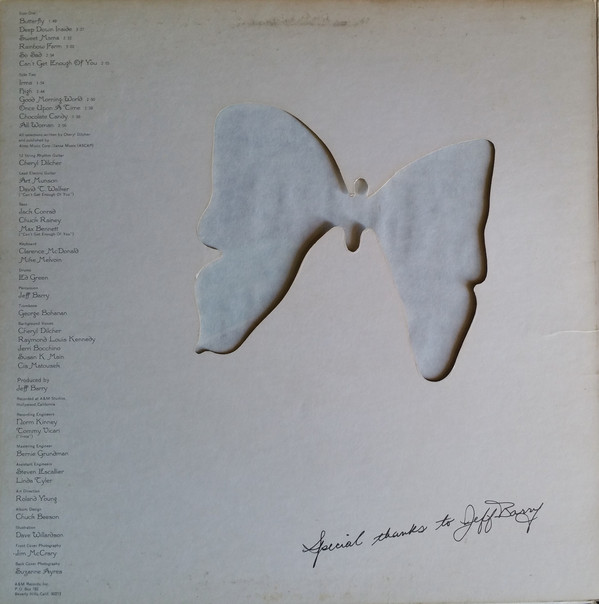
3 from Cheryl Dilcher (1973, 1974. 1977)


I mean, those album covers are priceless, aren't they?  What do you think of the cat chasing the butterfly?  And the static electricity bad hair on Magic?

I skip over her first album which I found to be uninspired folk rock of the most generic kind.  Her discography is here.  This is more of that seventies pop rock I can't get enough of, less folky than the earlier Leslie Duncan, but with nice moments.  She progresses to get harder, more electric, and more uptempo by 1977. The best album is the middle one with the crazy cover.  Title track of Magic is really instrumental Magic for sure:


Sunday, 1 November 2020

Danny Kirwan's Three solo albums (1975 to 1979)


Is it ignorance? I had never heard these 3 before, nor was I aware of Danny's existence in the Fleetwood Mac I always hated due to the ubiquity of Rumors, Stevie Nicks, and the rest of that coke-addled incestuous semi-family.  But his music here is just remarkably accessible and mellow, inventive rock-based singer-songwriting full of interesting arrangements and memorable hooks, particularly the first with its absolutely gorgeous cover and back art.  Musically, so similar to my favourite Michael de Albuquerque (I posted those in comments attached to Ricotti here), and also the beautiful gems Mike Hugg (Manfred Mann cofounder) made in his two early 70s LPs. 

Only the VIPs are in wiki (like wojak, but not moth meme):

Daniel David Kirwan (13 May 1950 – 8 June 2018) was a British musician whose greatest success came with his role as guitarist, singer and songwriter with the blues rock band Fleetwood Mac between 1968 and 1972. He released three albums as a solo artist from 1975 to 1979, recorded albums with Otis Spann, Chris Youlden, and Tramp, and worked with his former Fleetwood Mac colleagues Jeremy Spencer and Christine McVie on some of their solo projects.

Discogs info here.

It's hard to deny the beauty of the title track of Second Chapter which starts so inauspiciously with a country-bluegrass guitar intro but then mellows out into expansive and heavenly beauty:

There are so many things in there that are priceless, notice the descending chord changes that give you that feeling of going deeper and deeper into a novel, notice the electric keyboard playing gentle chords in the background, the second verse suddenly leading into a string section for the bridge describing the pastoral scene.  The instrumental segment in the middle even has an easy listening strings solo!  Later a french horn pops up. Like I've said so many times before, how come such a wonderful song is not well known and played on the radio today?  And why wasn't it a huge hit back then, to be made appropriately famous?  (Btw arrangements are by Gerry Shurry, never heard of him before.)

From the 2nd album, which on the whole is noticeably more poppy and less turgid with creative ideas, the Misty River:

Pretty amazing West Coast AOR rock, with the twanging 12-string guitars.  A highly versatile songwriter, clearly.

From the final album with its silly cover and equally sillyific title, normal I guess for 1979 (remember Led Zep's In Through the Out Door?), the Caroline track instead recalls the lovely Colin Blunstone who I hope everyone is familiar with:


Perhaps the most surprising thing to me about this music when I heard it was how much superior to Fleetwood it is.  In fact, I don't think Fleetwood in all its incarnations ever crafted an album as perfect as Second Chapter.  I'm going to spit on those old Rolling Stones critics who went nuts over Rumours and the AM radio stations that played Dreams (with its total of two chords in one whole song!) over and over and over again, all the way to this day playing it over and over again.  A song that really should be put to rest finally.
I think in a way he was cursed by his association with Fleetwood Mac, who became such mega-superstars in the late 70s that pretty much their whole long past history was erased.  It reminds me of what happened when Phil Collins and Peter Gabriel became hugely huge in the 80s and people just ignored their Genesis output, glossing over it almost as if it was an embarassment when rather, today, we think their later songs are the embarassment. Right, Sir Ss-ssudio?


Friday, 30 October 2020

Stefan Nilsson again with the earlier Det Är Nu Först Jag Ska Börja (1980)


This album features Stefan on acoustic piano.  Note that he's accompanied at times by saxes, marimba or vibes, and harmonica on the first track which is a complicated blues number.  I was curious about it since it came just before the Music for Music Lovers masterpiece, in 1980.  But too many of these pieces sound like etudes written for a classical composition class, same drawback as the Romantic Piano LP I ripped earlier this week.  The slight progressive ideas of the third track are the best material:


I'll hopefully be back later on the weekend with more interesting material.  The hunt continues.

Wednesday, 28 October 2020

The amazing Stefan Nilsson: Music for Music Lovers (1983) Romantic Piano (1985)


It seems almost criminal that his solo works are almost forgotten.  On this blog I presented the stunning progressive songwriting collaboration he made with Thomas Korberg (from the well-known Swedish band Made in Sweden, followed by Solar Plexus)-- an LP which remains for me one of the most beautiful albums I have ever heard in this lifetime of seeking out advanced and unique music; but following this he made three more albums of which the (prog) highlight is Music for Music Lovers (1983).   For music lovers indeed-- no simple-minded commercialese-enamoured lowlife with a small acoustic cerebral hemisphere could ever enjoy this intellectual, advanced, delicately varied, and very thoughtful album and I can only imagine what a horrific reception it must have received in the year 1983 when everyone was obsessed with Duran Duran, simple chords on digital drums, and I want my MTV.  The title track pretty much says (musically) it all:


Before anything more, Stefan Nilsson:

Swedish composer and pianist, born 27 July 1955 in Kukasjärvi, Sweden.

On this blog we have already heard plenty from him when he played super-energy fusion with his band Kornet.  Boy do I miss those days.  I wish the fusion trend could've lasted forever.  Following which, he was in the short-lived one-off band with guitarist Coste Apetrea (from Samla etc.) De Gladas Kapell.

Subsequently Stefan made this instrumental piano concerto-type record with an easy listening style string orchestra-- well, I should say it's more of a complete classical orch, don't want to insult anyone-- presumably to showcase his classical composition skills.  I can't imagine how unpopular this must have been in the mid-80s when already 'muzak' had such a bad rep.  This is not as progressive as the previous record, though he is capable of some very intriguing composition as in the track very atmospherically called Morning Mist:


Credits:

Stefan Nilsson - Steinway piano, keyboards, QX-1 sequencer
Strings from the Royal Opera House Orchestra
Conducter - Örjan Fahlström
Orchestra leader - Zahari Mirchew
All songs composed by Stefan Nilsson (except 5, Michel Legrand)
String arrangements - Stefan Nilsson
Produced by Stefan Nilsson