Friday, 30 May 2014

Frank Robson ST, 1974


Yes, the cover is a little bit ridiculous, but many thanks to my friend for purchasing this record and reripping it, a poor mp3 was circulating for some time, and this really deserved better.  I'd be particularly curious to know if the formidable song "A House without a Name" became a radio hit, which it should have been, being multiple orders of magnitude better than any old hit song they play ad nauseam on the radio stations...  The title track from the next album "Stay Awhile" is just as brilliantly beautiful.

Here are those two hit songs:


Why aren't these songs played on the radio every day, like "Michelle, ma belle" which everyone should surely be sick of by now, for some new interest?  It boggles my mind.

His voice, though deeper, recalls to me Al Kooper, as in the gorgeous album "Super Session" he did with Bloomfield and Stills, and I really love the intensity of his passionate vocal cords.  A natural singer without a doubt.


From my friend:

"Frank Robson, UK singer, pianist and organist, moved to Finland in 1967. Before that, he had been playing for some time with the Small Faces, among others. In Finland, he has sung and played in bands, for example, Mosaic, Blues Section, and Tasavallan Presidentti. Robson has also released five solo albums. Robson has two daughters, one of whom, Jenny Robson, is a singer."

I wonder what happened to him after the mid-seventies, he no longer became active?  Anyone know?
http://www.discogs.com/artist/653498-Frank-Robson

Wait a second-- five solo albums?  I only have two!  Once again the hunt is on...

Wednesday, 28 May 2014

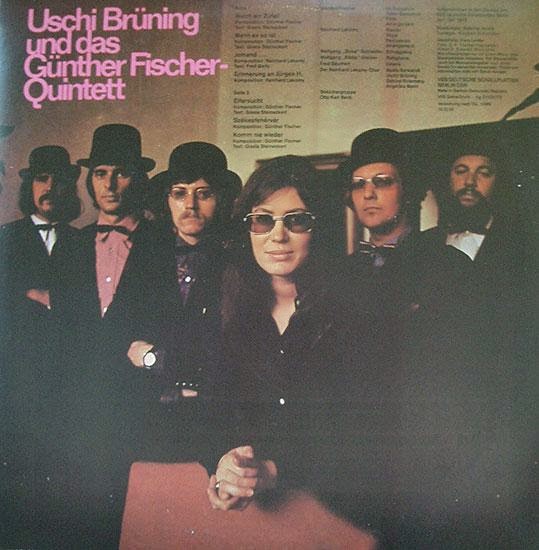
Uschi Brüning Und Das Günther Fischer-Quintett, 1973 [strongly recommended]


Obviously, after hearing the glorious latter half of the above amalgam as it appeared on the utterly unforgettable vinyl "Kombination", I checked through the discography to see what else might be interesting.  The albums credited to Manfred Krug + Günther Fischer-Quintett looked terrifying to me, in fact, I never got past the first track on "No. 3" which is the abominable "Que Sera Sera" -- a song so damnable, that, it is said, the US military has begun using it in their patented torture protocols for suspected terrorists along with those bizarre black hoods, and naked women, and in fact, in their newest weapon, the long range sonic gun which apparently can 'shoot' music at high volumes (on the order of 150 decibels) in a very narrow beam directly at, for example, Somalian pirates interrupting important Walmart shipments of tupperware to Dallas, or innocent senior citizens protesting against the Government reading each and every email and sexually explicit text message they write, such songs (like "Sign, Sign, Everywhere a Sign" which is my personal most-hated song) are employed for good effect.  In the meantime my own patented long-range sonic acoustic gun, which I call 'my two boys,' has still not yet been developed and deployed by the great ol' US Army... which I hope never happens, of course...  There is a (Hungarian?) folk song entirely composed by Gunther Fischer in the middle of side b that is instrumental, improvised in fact, of which perhaps the first 15 seconds are interesting, after that it begins to drag as we get to the fourth and fifth minutes, some perhaps will be tempted to fast-forward, others, to use it in their nice new US sonic guns (which will soon I am sure be legalized like all other guns there, perhaps even mandatory) directed at a nearby squirrel in one's backyard; the great US gov't itself could use it in a later campaign against the Iranians guilty of the unforgivable sin of modernizing themselves past the nineteen-forties when the atomic age is said to have begun at least for western powers (plus Israel), and if that war starts, which I hope it won't, as usual it won't be the leaders who will suffer but instead tens of thousands of repressed citizens will be sacrificed for a regime they had neither stake nor faith in...  luckily, there will be very few US casualties, we can be fairly confident.

Anyways, back to this release, which is formidably good, fresh, tasty, full of inventive songwriting, as you'd expect from this period in time when culturally everything was fermenting, like the genital tract of a very popular and reckless prostitute...  I am not too enamoured of the voice of Uschi, never mind that the name always reminds me of the immortal swedish softcore porn star Uschi Digard (or rather:  here) who was omnipresent in European movies of the seventies, including several of the great Russ Meyer's; here of course she (I mean the singer) bears the most unfortunate resemblance to Janis Joplin, not quite of the same level of interest for most of us men.


First of all consider the first track, "Welch ein Zufall" (i.e. what a coincidence).  I was quite blown away here by the chord progression Gunther wrote, it starts in a nice bouncy typical sixties G minor to A minor repetition, but subsequently I almost fell out of my chair when the verse transitions into  A♭ major, which then drops down to E minor.  Surely a completely verboten sequence!  Then, picking up the E minor, we get a relatively standard upgoing series from E minor, F♯ minor, G, A7, ending up at a tonic of B minor prosaically going to E7.  Without more ado after the chorus the verse starts up again with the G minor / A minor.  Pretty cool, right?  Esp. the anomalous A♭ to E minor.  We can understand how it works if you interpret the A♭ as an F minor going down to E minor.  Brilliantly unexpected though.


Then the album closes out with a really beautiful ballad written again by Gunther and orchestrated with a nice topping of delicatesse.  I wonder how important it might be track down the rest of his compositions on the strength of this last track, he was clearly quite skilled with almost pure Burt Bacharach aptitude at crafting popular-sounding songs with just a nice edge of originality, unusual chord changes, and utter interest especially when compared to the standard pop song progressions like 1, 2 minor, 5th.  This particular entry has a couple of unusual changes in it too including the verse dropping to the 7flat chord, that is, verse starts in G and ends not in D7 or G, but in F, which was a hallmark of early AM radio, e.g. Jimmy Webb's "By the Time I get to Phoenix".  As I understand it, in this song she is telling him not to come back again, because they were friends, just friends, and she thought that was enough. Believe me, she says, if it wasn't so, she would be saying other words to him.  Wonderful stuff.  What a romantic sound and song.

Here it is:


One last note, obviously this recording was made in East Germany, behind the Berlin Wall...  I'll save the commentary about communism, the greatest crime perpetrated against humanity, by humanity, for a later post, or more accurately, many previous ones on prognotfrog.

Fantastic album.  Great find.  And all thanks go to me, this time-- not my friends! lol


Sunday, 25 May 2014

Negasphere - Castle in the Air (Japanese classic prog from 1984)


http://www.discogs.com/artist/1679759-Negasphere

http://www.discogs.com/Negasphere-Castle-In-The-Air/release/4076736

From our pnf friend Apps, rateyourmusic:

"Among the lesser known names of the Japanese prog scene, Negasphere started in 1977 under the guidance of bassist/keyboardist Kawasaki Kaoru.In 1981 they were joined by Majima Hiroyoshi and Kaoru devoted himself only to the keyboard parts.Reputedly the band had a self-titled live cassette out around the time.Problems with the line-up prevented the band from recording an official LP and the problem was solved with the addition of ex-Mahojin Sugano Shiro on drums, Yata Toru on keys and Tokutake Hiroshi on bass.Finally a LP entitled ''Castle in the Air'' saw the light in 1984 on L.L.E. Records.

The sound of Negasphere was exactly in the middle of GENESIS-inspired mellow Symphonic Rock and the more fiery Symph/Fusion style of U.K. with good arrangements, extended instrumental parts but also a very mediocre recording quality.The band keeps a nice balance between vocal moments and long professional instrumental sections and there is always a mood for changing themes throughout.So a calm, mostly symphonic section with dreamy keyboard work and sensitive guitar parts is often followed by sharp and often double synth attacks, dynamic interplays and powerful grooves with an evident HOLDSWORTH edge on the guitar solos and a sound close to WAPPA GAPPA or MONGOL.Vocals were never the strong point of Japanse bands and Negasphere make no exception.Still the lyrics are sung in English with a bearable performance by Hiroyoshi.The biggest flaws come from the below average production and the plastic sound of electric drumming.

A very rare record by Negasphere yet a recommended release for fans of 80's Japanese Prog and all those who love the combination of 70's Classic Prog with Fusion."


Just a quick note, indeed there is a highly collectible live album from 1981 this one:
https://rateyourmusic.com/release/album/negasphere/live/
Needless to say-- it's their best work by far, but the sound is not very good.  Strongly recommended.

Friday, 23 May 2014

The fusion that's Heliocentric (USA,1979)


I really couldn't resist buying this without knowing anything about the contents when I saw the highly attractive surrealistic cover with the metronome oddly flat on the table and thus nonfunctionable, the window showing a reflection of the metronome in front of a sandy path outside and self-referential other window, the blind handle echoing the pendulum, etc.  The artist here is Norm Scutti, who also plays drums.  He is rounded out by Al von Seggern on horns, Jeff Pressing on keyboards, and John Leftwich on bass.  The whole was recorded in March 1979 in San Diego, California, thus, 35 years ago...

The rear features the following little blurb worth reading:

"This album presents nine original compositions with each piece exploring a different musical territory.  The use of untraditional harmonic changes and rhythmic concepts evident in this music evolved from the group's inception.  We began as a group whose premise was aleatory or spontaneous music.  From this grew a sensitivity to dynamic interplay which has resulted in a unique group sound.  This sound together with the writing creates a raw spontaneity in the recording.  With a minimum of overdubbing we feel the loose gut-level funky side of small group playing shines through.  What follows is a brief description of the compositions..."
--Norm Scutti and Al von Seggern

For example, the first track Afferent Connection is described as "contemporary latin-folk in 6/16 meter with solos alternating between all members of the group..."

Ridiculously, the drummer has two spoken tracks at the ends of each side, in which he explains the group, thankfully only for a few seconds.  I don't think I've seen such a curious exposition before on a jazz record and it seems to me quite unnecessary.

Note that the first side is entirely composed by keyboardist Jeff Pressing, while on side 2 there is more involvement from the others.  An entirely improvised track is credited to the whole band ("Town of Dog").

I don't think the spontaneous aspect is very much to the fore here (thankfully I might add, with the exception of "Town of Dog"), rather, the laidback acoustic jazz sound most reminds me of Listen featuring Mel Martin which I ripped some time back, minus those annoying steel drums of course.  Despite the promise of "untrad. harmonic changes and concepts" (i.e. progressive composition) the amount of unusualness evident here is slightly below our stratospheric standards at this late stage in the game where like the jaded and debauched Romans in Petronius' Satyricon, we are always seeking some new unheard chord progression, dissonant interval or rifflike angular melody to punch our jugulars and entertain our palmares-weary receptive auditory neurons and higher cortices...

The spoken prose poem or very short story that accompanies "Town of Dog" is well worth listening to for its amusing plot and subversively surreal changes and original phraseology (but not the improvised music).  I will paraphrase the majority of it but not quote it verbatim, not having the time for it:

"In the Town of Dog there lived six cats.  Two of them, Hibble and Thnork, were employed as wine-sniffers, by the local vineyards.  This, many said, was what was responsible for their chronic inebriation, matted fur, and good-hearted sense of humour.  Though there were those who felt their sense of practical jokery bordered on the macabre.  Let me tell you about one of their exploits.

Douglas, who went to trade school, studying to be a plumber, now enters the story inasmuch as his brother, Frank, tripped over Hibble and Thnork as they were making an important grain purchase for their hogfarm.  What was worse, he was carrying his bombastophone, on which he was a performer of international repute.  Unfortunately the instrument fell, and was cracked beyond repair.  Needless to say, Frank had few kind words for our friends, Hibble and Thnork.  Their escape was via one of the many cubbyholes, cut into the sides of the store and a very narrow one, it was indeed.  In fact, Hibble's tail became entangled by some wiring which had become stuck to the outside of the opening...." 

And this is how the story ends.  Really love it.
Here is a wonderful track called Leaf:


(Gotta love how they employed electric instruments back in the day...  Where is all that electricity now??)

And here is their surreal cat story for those who wish to hear it:


Wednesday, 21 May 2014

Alex Blake - Especially For You (Japan, 1979)


First of all I wanted to draw your attention to comments made by the sax player, Randy Keith, from Spaces - Border Station.  It's so interesting when an artist is able to give insight into a recording!  Please read comments at the bottom here.

After hearing the "Dreams" song from Danny Toan I felt I had to get this and listen to the original version, which has vocals, written by Alex Blake.  So the whole record is ripped for you here.  Unfortunately, both the record and the original version are relatively ordinary, humdrum, funk-rock with very little merit.  There are a few bass solos that are to me slightly agonizing if not downright traumatic. This record was released in Japan, as you can see from information here.

From discogs:

American (but born in Panama) jazz double-bassist and composer.
Played with : Lenny White, Billy Cobham, Pharoah Sanders, Randy Weston and others.
He also recorded as a leader.


More information, from jazz times:

“I started playing professionally when I was 12 years old,” says the Panamanian-born, American-bred bassist Alex Blake. “The music I was playing was Latin; I was playing with great percussionists like Kako and Patato.”
He’s also played with some of the biggest names in jazz: Dizzy Gillespie, Manhattan Transfer, Freddie Hubbard, Lenny White, Randy Weston, Billy Cobham, Sonny Rollins—”You name the groups, and I’ve played with them…I can’t even remember some of the groups I’ve worked with, there’s just so many.” Blake also toured Europe when he was 16 with Sun Ra and played an extended gig in Chicago, far away from his New York home. “I was kinda skipping school a little bit; my parents were a little pissed off.”

200012_026_span3


So how did the nearly 50-year-old Blake, who’s been around the world and back with high-profile bandleaders, elude entry in The Biographical Encyclopedia of Jazz and The New Grove Dictionary of Jazz ? And how did he only now release his aptly named second album as a leader, Now Is the Time: Live at the Knitting Factory (Bubble Core), featuring his quintet with Pharoah Sanders? “I had offers, and I wanted to do an album, but I had other things in mind; and I was so busy on the road, going out with the Transfer…I love writing, so I have a lot of material. Over the period of 1970 to now I don’t know how many tunes I’ve written…”
Blake’s first album as a leader, Especially For You (Sony), came out in 1979, but only in Japan; Now Is the Time marks his American debut. Bubble Core co-owner Adam Pierce, who plays vibes, bass and percussion in the dub-jazz duo The Dylan Group, saw Blake in performance and was so knocked out by the bassist that he offered to release an album. While the Bubble Core is eclectic, it has focused mostly on experimental electronica and rock; Now Is the Time marks its first straightahead jazz release—and it’s an auspicious debut.
In addition to Sanders, Blake’s quintet includes pianist John Hicks, drummer Victor Jones and percussionist Neil Clark. On Now Is the Time the group tears through three Blake originals and a cover of Guy Warren’s “Mystery of Love”—though “On the Spot’” is based on the changes to John Coltrane’s “Giant Steps.”
“I was in Norway with Pharoah Sanders last year. We were rehearsing and we started going through a couple of tunes…and all of the sudden this tune started coming up in my mind, and the first couple of changes were like ‘Giant Steps.’ At first I said, ‘No, no, no, I’m not gonna go there,’ but it just kept staying there; it just wouldn’t go.”
Blake cites Richard Davis, Jimmy Garrison, Reggie Workman as bass playing influences, and also Jimi Hendrix and Eric Dolphy. Despite having a strong background in Latin music, however, Blake’s compositions don’t reflect that experience; but his bass playing does. “It’s a strumming technique; it’s like having a guitar and congas and putting them together with the bass. It’s a construct of strumming and playing the congas; that’s the percussive side of my playing. That’s the concept of my playing.”
Blake demonstrates his full arsenal of percussive techniques and lyrical lines on a remarkable solo performance of The Beatles’ “With a Little Help”: His bass playing sounds like an a cappella jazz singer improvising on the melody. It’s one of the few times Blake spotlights his own playing during the gig.
“On this album I was in the crossfire trying to decide whether to play a lot of solos or not. I didn’t play a lot of solos on this album; on the next album I plan to really do a lot of solos. I was more emphasizing the writing. Plus, I was so burnt out from travelling and playing and travelling and playing and so on and so on…the total energy wasn’t there.”
You wouldn’t know it from his spirited performance on Now Is the Time. ..


And now have a listen to the original Alex Blake version with vocals (please be forgiving):


This piano intro reminds me a lot of the unforgettable skit of Dana Carvey on SNL 'Choppin' Broccoli'.
And doesn't that chorus sound so muddled?

It's interesting to me how Danny Toan managed to craft such a gorgeous song from such unpromising material.  I've mentioned before how dreadfully I despise the downgoing minor chord progression especially starting from A minor (that is, A minor, G, F, sometimes including an Fsharp before, sometimes ending in the E), e.g. "While my guitar gently weeps"-- and of course the reason it usually starts from A is because that's the easiest version to play on the guitar-- god forbid someone should try to write such a progression starting from Eflat minor!  After "Stairway to Heaven" everyone sounds derivative when they try to use it.  Of course, Jimi himself (earlier) reinterpreted Dylan's bland song "All Along the Watchtower" and made it rock gold, with the echoey acoustic guitars hammering away at those tired old chords, and the laidback electric soloing and wah-wah running like a complex weaving pattern all through the song.  In that case I can still listen to the progression with enjoyment, but then I've been a lifelong Hendrix fan.  Also observe how Danny took what is just a bridging section between chorus and second verse, with the stepped up 4th intervals, and made it into an intro for the song-- these stepped chord pattern intros have been used before, e.g. Joni Mitchell's Jericho, or Fruup's masterpiece Gormenghast song (in my opinion the most brilliant use) but Danny tightened it up (which it really needed) to make it a true intro-- just genius.

Again, Danny's Dreams Come and Go: