Thursday, 29 September 2016

(Klaus Lenz) Modern Soul (Big) Band in 1974 and 1976


Not surprisingly, the earlier 1974 album is the better of the two, with Lenz still involved as leader.  Curiously, and to their detriment in my opinion, both of these are live albums.

But the track Fusion is magnificent, with its classical compositional intro developing the theme:


Oddly enough this track or at least its name reappears in a 1978 album by the same name when the band is rechristened the Jazz and Rock Machine (like Dauner's United Jazz and Rock Ensemble, though Machine is definitely much punchier).  I couldn't tell if it's the same song or a different one.

For the 1976 album there is no sample, and that says it all.


Tuesday, 27 September 2016

Toto Blanke Compleat from 1975 to 1984


In a period of under a decade this astonishing guitarist annually made a series of masterpieces in the style of progressive fusion.  Some people out there might not have all of them, in particular, the last 1983 LP is worth hearing though it will inevitably disappoint in terms of its pandering to the latin and simplistic influences that affected all of fusion and jazz come the eighties.

In the beginning of course he was with the group Association P.C. (named for Dutch Pierre Courbois, the percussionist).  All those records are well worth hearing.  Following this he set out on his own with Spiders Dance which was quite reminiscent of the earlier band.  (Note the first track adorably called Lady's Bicycle Seat Sniffer.) The next album created the name Electric Circus and introduced the synthesizer for playing lyrical melodies to excellent effect.  Subsequently here the discography uses the EC term for another genius album, the one called Friends with Stu Goldberg (on keyboards).  The 1980 live album called Family was to me disappointing, with the sidelong jam Bolero being way too uninspired and what is worse, a crime for me in staying in the key of E throughout.  Note that 1978's Tales of Tomorrow was played almost entirely by Toto.  For me this is his masterpiece.  In the 1980s he switched back to acoustic guitar with a couple of guitar duet albums, the first with Rudolf Dasek, the second (Somewhere in Time) with himself.  That album I reviewed here:

When my wife saw it in the mail she actually said, "Is that another Toto Blanke?"
Alas-- when I looked at her, the grin on her face made it clear: a name she had heard me say many times before, had become a very dry kind of joke...  In 1969 legendary belgian percussionist and jazz bandleader Pierre Courbois founded the first European 'Rock-Jazz' group, Association P.C.. This famous ensemble, winner of the Down Beat Poll, existed until 1975 with Toto Blanke, Sigi Busch, different key-boarders, including Jasper van 't Hof, Joachim Kühn and Sigi Kessler.

Finally as mentioned above, the last 1983 album Belladonna inevitably disappointed.  Notwithstanding I prepared a new stereo rip as the previous one was in  mono.

So there you are, eight albums total.

Sunday, 25 September 2016

Springbalance Litfass (or vice versa) 1977


This is a one-off private pressed album, sadly.  It's been a favourite of mine for some time now.  Just from the titles you can tell we are dealing with some very very creative types, especially when the first song right off the bat is called Salmonella.  Guitarist Dietrich Jeske seems to have been the mastermind of the band.  Consider the track Pull in Moll:


I love how the chords here throughout wander between e minor (the moll of the title) to b minor, d minor, G7, having normally nothing respectable to do with each other, without any warning.  Yet the cohesion is palpable, despite the fact these progressions break the rules of musical theory.

To me that's one of the hallmarks of great art: using a well-established or culturally traditional template, the great artist is able to break the rules with such finesse that we are compelled to agree: the rule book must be rewritten just for them, for this one incident, or their many incidents, of delinquent misbehaviour.  Thus they enlarge piece by piece what is possible for us humans.  (Think, for example, of when George Martin in 1962 or whatever decided to add a string quartet to the otherwise trite McCartney ballad Yesterday-- how many acoustic guitar songs were then subsequently fitted out with the same...)

Our final poem Frühlingsgefühle continues the very meditative and melancholy tone of the album with its tender violin intro.  An augmented major chord is then used, with descending chord patterns, to good effect to express the obstacles of sadness in our daily lives, with the downgoing melody describing the pain.
(Now imagine my shock when I found out the title is equivalent to the English "getting frisky!")


I guess some things in art are just inexplicable.  Like how people can accomplish so much with pure creativity and original ideas...


Wednesday, 21 September 2016

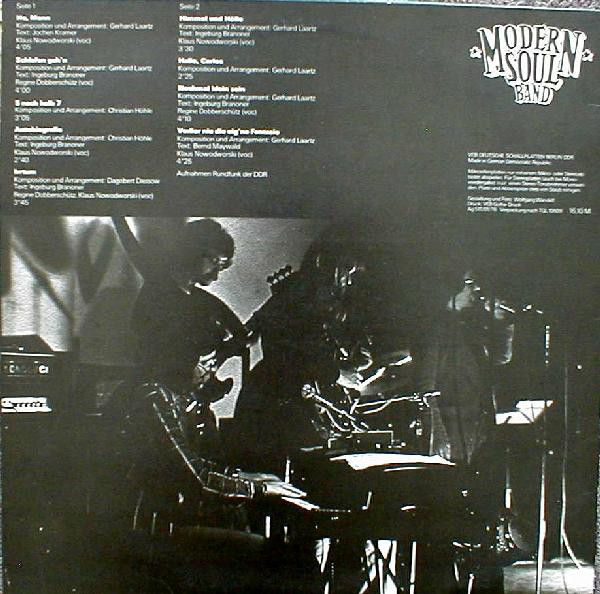
Meeting with GDR's Modern Soul Band (1979)


OK, here we go with more large German soul-rock bands with one foot in the fusion scene, the other in a commercial cesspooled septic tank.

This is an offshoot of the Klaus Lenz project Modern Soul Big Band...  Klaus Lenz was presented here earlier as a master of GDR fusion with his two big mid-seventies masterpieces, and accompanying Uschi on a 1974 record that proved slightly disappointing.  I presented his bio in that earlier, earliest post and won't repeat it here.

On this record there is a Klaus, but it's a Nowodworski (specifically, on vocals), not a Lenz.  Note also that arranging credits are ascribed to one Gerhard Laartz and compositional credits to a number of musicians: Gerhard Laartz, Joachim Schmauch, and Wolfgang Nicklisch.  So Lenz no more.  However, they did have an ST release 3 years before which seems to have involved him.  I'm not so sure, since his presence usually brings more creativity, of which that ST is lacking.

But the stunning closing instrumental Meeting hits all the right notes both musically and fusionally:


To summarize or perhaps to clarify from the above random notes, there are two related albums, the ST Modern Soul Band from 1976 and the original from 1974, which was called Klaus Lenz' Modern Soul Big Band (the better album).  Both I have and can post on request.


Monday, 19 September 2016

Ocean Orchestra, from 1979 Germany [lossless available]


Sadly we present this too late for the glorious summer just passed to which it would have been a fitting tribute, coming from the one-off Beach Records...  thanks to my friend for ripping in such a professional manner and allowing us to share here.

Another huge German soul rock band here with the population of a small village in the Alps, their LP is a bit of a mixed bag with some ordinary rock, soul, but some very interesting instrumentals without which I wouldn't have bothered to post.

This large cruiseship seems to have been anchored down by H. Gronemeyer (who, oddly enough, acted in the most famous German movie of all time-- Das Boot-- and who later founded a record label) and Bernt Laukamp, a trombonist and composer.

Part Two of You Can't Win:


A stunningly exciting and dramatic composition by one J.P. Ostendorf who was clearly, for most of his life, a 'modern classical' composer.  His presence in this band should provoke a little bit of surprise, especially since some of his contributions here are quite poppish, though it seems analogous to Jobski's (who composed the famous prog LP Einstein in Eden) in the previous Messengers band.

Note also the appearance of M. Stockhausen (who is credited with the wonderful track B3, Song of the Waves), son of the famous composer Karlheinz generally considered one of the greats of 20th century music:


Trumpterer/composer Markus had a great discography with the albums Aqua Sansa (with master J. Van't hof) and Continuum (with Burninghaus) both highly, highly recommended, being thoughtful, gorgeous and well-written ECM-style jewels.

How unfortunate those two masterminds couldn't have stormed the bridge of this oceangoing vessel, manned the helm, and steered them towards some really progressive sounds-- would they then have made too many waves?