Monday, 2 April 2018

Theo Schumann in 1981, East Germany


It's hard to follow up last weekend's post I know, but it's our obligation to keep on truckin' here.  So let's move from West Germany to East for a peek at some novichok music.  From discogs:

German pianist, saxophonist and band leader, born 24 July 1928, died 21 July 1990. [At age 62!]
Leader of Theo Schumann Combo.

From wikipedia translates:

His father Otto Schumann was master tailor, he coined the musical development of his son Theodor. He made sure that Schumann practiced daily for six to seven hours. After completing his 8th grade, he applied to the Dresden Conservatory , where he completed his studies in clarinet and piano. After the war he played in various dance music orchestras. In 1956 he founded his first jazz quintet.

After studying classical music at the Carl Maria von Weber Dresden University of Music (subjects: conducting, composition, piano and clarinet ), Schumann founded the Theo Schumann Jazz Formation in 1957. From 1958, he was the bandleader of several jazz bands and composed numerous pieces.  The Theo Schumann Jazz Formation formation played in the Dresdner Parkhotel , for example , where jazz concerts were held every Monday. He was well known in the jazz scene and also gave guest performances in West Berlin . He brought out two records.

Instrumentation
Theo Schumann: Hammond organ, electric piano, piano, ladder; Jochen Kittan: Bass; Frank-Endrik Moll: Drums, Percussion; Konrad Körner : tenor saxophone, flute; Hubert Katzenbeier : Electric violin, trombone

Theo Schumann Combo 
From 1961 to the mid-1970s, Schumann directed the Theo Schumann Combo , which played both self-composed pieces - mostly instrumental dance music - as well as cover versions of Western pieces of music (such as Satisfaction by the Rolling Stones ).

With Theo Schumann Combo Schumann turned to commercial pop music. Within the GDR he gained great popularity, his hits were often played on the radio.


So you can see he was already a ripe 53 when he made this one, and unlike what I said about Thollot, the maturity shines through splendidly throughout.  Here, for example, the gorgeous goodness of Grünes Gewölbe:


Smoothly perfect, perfectly smooth fusionary visions, with Kiril Wlatschkow on trumpet.  Channeling my old college favourite Freddie Hubbard, perhaps.


On this record, Honolulu comes across as a Miles Davis So What jam, oddly enough (unlike the atmospherically expressive version of Jukka Linkola):


But I like that he strays outside the conventional series of chords.  Even more surprising, and perhaps typically European, is how the subsequent track called "Honky-Tonky" is completely unlike the musical style of the title save for some bluesy moves from the flute soloist, being quite post-modernly deconstructed.

Altogether a fabulous slice of oblivion and I'm looking forward to more from this fantastic composer.




Friday, 30 March 2018

Happy Easter and German Nimbus (1980) by multiple requests


Here we go, the biggest request of all time.  Happy Easter to all you true music lovers out there!

Posted before where it was written:


I hate to do this to you again Tom but I will simply quote your recent review at this time before adding my own thoughts to your inevitably correct assessment:

Of all the albums in his latest dig, I have to say Nimbus (Germany) is one that I keep hearing about, but never have actually heard. Its reputation is stellar, so does it live up to the "hype" as it were? I use the term hype carefully, but I fear to say that there are many out there who do, in fact, hype this one to me. As in "buy my CD-R... now!" (I don't buy or trade CD-Rs, but that doesn't seem to stop the solicitors of such).  And one can't possibly have a deep dive expedition without at least one Kraut Fusion album, now can we?  "Yet another instrumental progressive fusion rarity from the vast German private press scene. But this one's a cut above the norm, with excellent compositions spiced with a healthy does of progressive rock, keeping things interesting all the way through. The keyboard work in particular stands out. Unfortunately, the sound could do with some cleaning up, which makes a reissue all the more necessary. This is certainly in the top tier for this style, so hopefully one of the German labels will step up to the plate someday."

The music is as The AC describes, a highly melodic instrumental jazz rock album, with guitar and keyboards in the lead. Bands like Surgery, Mosaik, Moira, and Profil are all good guideposts here, and all just as obscure as hell too (though at least the former did get reissued by Garden of Delights

Priority: 3

I probably would have rated it higher, but I have more of a predilection for fusion, obviously.  In order to present a suitable track for sampling I elected to use the fourth track.  The first (Hymn) is a relatively simplistic, perhaps commercially oriented fusion or fuzak track, the second takes it a bit further in a symphonic direction with the summer's evening sound, the interaction particularly of rhodes and electric guitar make for a wonderful interplay, though the invention is not sustained to the end as I felt it should be.  As we often see in these situations, the third track is a throwaway noise thing, luckily less than a minute long.  The fourth is called Forum and it is here that you can listen:


Note how nicely the keys and guitar play together here, a big feature of this record's attractiveness.  Unfortunately, side b comprises the two long progressive and interesting tracks (Living and Sinus), particularly the final one where a kind of Crimsonesque ambition prevails.  Altogether, worth seeking out, and apparently on contacting band members, from where my own rip originated, they are quite open to a release of this work.  Perhaps if there is more clamour for it they will be more convinced?


Wednesday, 28 March 2018

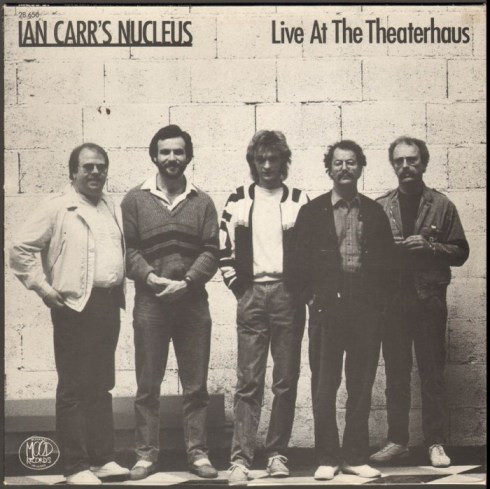
Ian Carr's Nucleus in Awakening / Live at the Theaterhaus by request


Hope this is what was being requested.  Let me know if not.  I included this 1980 release which subsequently came out as CD with bonus tracks including part of the other album.

In my opinion this doesn't have the same wildness as the 70s work and the tracks are really overlong.
But it's still worth hearing as indeed is everything they produced.


Monday, 26 March 2018

1989 French Avant Garde or RIO band Nptolpqsivrt ‎in Malaise [review only]


This oddly named band made two releases in the later eighties. Check out the name of their trumpeter and composer!  They are basically a chamber orchestra that plays some perhaps improvised, perhaps composed modern classical music with that typical Rock in Opposition sound of slightly jazz-inflected bizarro tunes carried by brass soloists, all instrumental, along the lines of Art Zoyd or Univers Zero, or as my wife often says to me while listening to these LPs in the car, "why does your music have to be weird?"  To those who don't understand, of course, there will never be appreciation, like Einstein's general theory of relativity understood when it came out by only a few people in the world (and even Einstein himself didn't know how to solve his equations except in a few simplified cases.)

A representative and somewhat approachable track is called Massacre by fingernail file:


And other song titles are equally amusing; note in particular there are 3 separate and differing compositions called Malaise.  For example, here's the second one:


And thus we endeavor to understand these Einsteinian musicians and their very odd relativity with the human corpus of musical art.


Saturday, 24 March 2018

Puzzlepie "Now", side 2, from 1989 Germany


Now I once again must give thanks to the generous friends who are willing to explore the musical universe out to the farthest depths of temporal and stackable space for these LP finds and their acoustic treasures that few can understand but whose value is absolutely boundless to those very few.

This is clearly an unknown entity as evidenced by the fact the usually haughty rateyourmusic cognoscenti are almost completely unaware (with the exception of one progressive champion), at least to this day, because you can bet that from now on this will change.

Side one is completely generic and conventional in songwriting, all over the place too, commercial oriented to a slight extent, but even so, not even enjoyable in the automaticity of the songwriting.  Suddenly all this changes when you flip over the vinyl and are treated to one of those side-long excursions into musical creativity that was a hallmark of progressive music in the golden age of rock with a mix of song, hammond organ chords, fusion, chamber music flute, electric guitar riffery, and an endless series of ingenious ideas, recalling mostly my pnf discovery from long ago Zauberfinger in its aptly named schizzo-rock.  At my count there are at least 8 different songs here that have been perfectly melded together in the most cohesive and naturally flowing way.  It has the wonderful title of "Twilight in Spin" and the refrain as I understand it is: "Meet me on the river Styx."

For this reason I won't bother to include a whole album here, just the magnificent side 2 which I urge you to put at the top of your playlist, pronto.... and thanks again to those friends who find these things hidden so far away from us...

Credits here, note the music is written by Stefan Karpati with the wonderful singer his wife Sibylle.
Unfortunately this is all they did.