




Actually that album is surprisingly well-written and non-fuzacky.
Anyways, hopefully you will enjoy these perhaps more than me.


It's nice to hear some truly progressive music again here after the endless progressive fusion I guess.


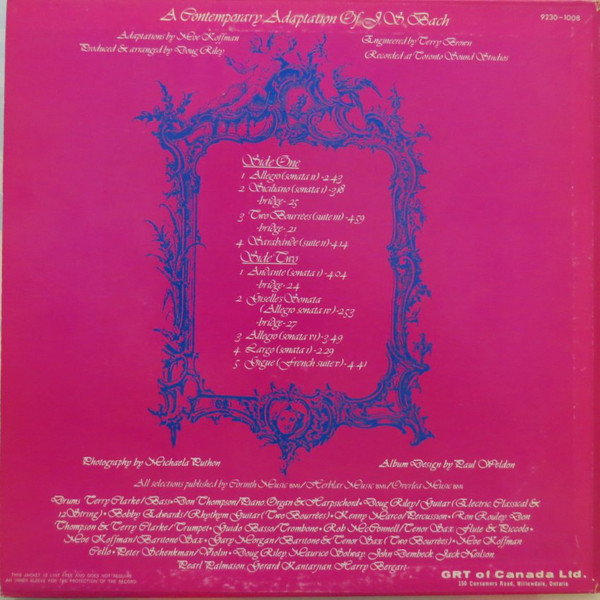
The situation here is very similar to that of Don Sebesky whose classical foray was posted here. Canadian Koffman made a great deal of really ordinary classical-themed music which I don't want to call fusion, e.g. the album Moe Koffman Plays Bach which came out in the early 70s, then went all-out critically-unacclaimed bonkers with advanced modern composition and extreme, and I mean extreme music with orchestra and fusionary visions in the 1974 opus Solar Explorations. The music is very similar to the last post of Carlos Franzetti but far more out there, way out into the intergalactic space actually way past the orbit of ex-planet Pluto and even the Oort cloud. And the vacuum of critical acceptance must have been just so rewarding... explaining perhaps why this was his only really experimental album.
Prior, the 1973 Master Session is still grounded in simpler classical music adaptations though it gets really interesting with the Syrinx track which though credited to him and Doug Riley, is really by Debussy:
I really love the feeling he put into that piece.
Speaking of fellow Canadian Doug Riley, he has appeared here before with the Dr. Music outfit he led. Their album called Transcription was a wonderful discovery I praise myself for posting here.
Anyways, the Explorations album is the real stunner, from beginning to end, primary composer Doug Riley again made an absolute masterpiece of the best kind of progressive music, mixing in equal proportions fusion, electric instruments, and modern classical of the most intellectual kind. The kind of thing I live to hear and die to listen to, and there were so many ideas he filled up a 2-LP set. And look at the stunning artwork they provided too! In reality it's solar system explorations with one track for each planet, like Gustav Horst.
Again, in sound very much like the Sebesky Stravinsky homage.
But it was all too much I guess, by the time of 1976's Jungle Man he had reverted to commercialese in the fuzak style. Nonetheless, his own composition called Temple Flower:
We wouldn't expect too much from the 1977 follow up themed Museum Pieces, but shockingly a really well-crafted and lovely composition by Don Thompson this time, appears as Days Gone By (Egyptology):
I love the way the chord progression, after a couple of generic moves, surprises with very original changes here and there, and throughout the song, so much so that the verse melody passes from F minor to G minor almost imperceptibly! Really lovely. The following track by Doug Riley about dinosaurs is also a real winner, resembling greatly his material from the Dr. Music fusion album that was so tasty.
Nice stuff. As I've said before, it's my thesis that the musicians or composers of the time were able to make such gorgeous progressive music thanks to their deep education and immersion in all three streams of classical, jazz, and pop or rock, one or more of which is typically missing today. Or all the above, in the case of certain musical styles.


OK, back to the relentless fusion now.
Gotta love the Farrah Fawcett-Major album cover. But they could've done so much more with that grafitti action. What an odd, odd decision to go with that as art for an album that is basically relatively standard progressive, slightly funky fusion in the typical American-latin style, in the year 1977.
From discogs:
Composer, keyboardist, arranger and conductor born on June 3, 1948 in Buenos Aires, Argentina. He is married to pianist Allison Brewster Franzetti.
He composed most of the music (but by no means all) on The Prime Element, for me a masterpiece of fusion. I'm not going to go through this one in detail because I assume everyone knows it already or at least is familiar with it from before. There is a great mix in there of latin funk, fusion, and surprisingly advanced, well-thought-out orchestral passages, which, it turns out, were all arranged and composed by the genius-- I don't hesitate to call him that-- Carlos Franzetti.
Moving on to 1977, amazingly the bonus tracks on the CD version of Grafitti are well worth hearing, surprisingly good for outtakes. So I included both LP and CD versions though there is little need to listen to the former. Title track of this 1977 release:
Moving on to Galaxy Dust (1980), the utterly uncompromising 'follow up' to Alborada I would say, the classical composition education shines through in a way that is simply astounding. Consider the track called Gravitational Forces which uses, clearly, an Alban Berg influence to craft and profoundly enhance fusion that is totally unafraid of the massive dissonances of atonal music from the early 20th century, including sliding passages on the violins:
We have to celebrate an artist so uncompromising, who was well aware at the time that barely 0.001 percent of humanity would appreciate this kind of formidable art, particularly at a time when it was no longer in fashion, it was, in fact, a complete joke to critics: those Rolling Stone coked-up assholes I hated so much as a kid and still hate, hopefully they've all ODed by now or died from transplant rejections after hep c and the change in livers and music styles.
Subsequently his Pavane is, from a starting position of French impressionistic elegance (reminds me of our old fave Satoh), a nice education in the intricacies of progressive fusion, again, unafraid of all that entails:
This is at least as good as most of the progressive fusion previously posted on this blog. A nice addition to our enormous collections.
Are you sure it's not the same album you keep collecting? you have so many already, as my wife always says...


Here's a complete change in direction from the relentless fusion.
Singer from Pointe-Aux-Trembles (Montréal), Québec, Canada. Twin sister of Richard Séguin.
I've mentioned these frequently as two of the most perfect albums I've ever heard in my life in the domain of progressively-written singer-songwriter. As such they compare with Wisse-Scheper Topaz' album from long ago, the stunning Nilsson-Tommy Korberg collaboration, or even to hell with it, Wigwam's string of brilliance with Pohjola culminating in 1974's Being-- well, I don't think actually any album could compare to that one in terms of pure progressive rock songwriting, along with their predecessors, Tombstone Valentine and Fairyport. So I take that back. Moroever I apologize sincerely to the prog gods for the sacrilege.
There are a bunch of familiar names from the seventies Canadian music scene here (specifically really the sui generis province of Quebec) including Neil Chotem who arranged the lot, Yvan Ouellet (who made the wonderful one-off Le Chant des Choses but who was a member of semi-prog outfit Ville Emard Blues Band) and plays the piano here and there, Serge Locat (known for his semi-good Transfert album), and even Harmonium's Serge Fiori contributed music too, along with flautist from Harmonium, Libert Subirana, though it seems most of the songs were written by her, along with a poet-lyricist (?) called Pedneault. Admittedly, the lyrics are wonderful too, with the achingly sincere emotions so characteristic of the times. Compared to today's "I'm in love with your body."
The most stunning track from 1979 with its dreamy mellotron and advanced compositional structure, almost like a short story in the drama of the changes, is Ou est passe mon enfance (where did my childhood go):
It's hard for me to even imagine a song more beautiful and desirable than that one.
Like Icarus this is as high as we can get with music, as close we can get to the sun without melting our wings... and the fall back to earth is so painful...
The subsequent track is called A tous les mal-nees (i.e. to all those born unlucky):
In the beginning of course she made 4 records with her brother Richard. Those are definitely not as good as these two, being mostly relatively generic and basic folk music, with occasional progressive touches, and in fact Richard's two solo albums which followed shortly after the dissolution of the sibling band are also disappointing--relative to Marie-Claire's two. So she definitely won the brother-sister war of progressive songwriting as far as I'm concerned.
Finally in the mid-80s she made another LP which was highly disappointing with almost none of the emotional depth of these two, and totally commercial, sad to say. This is similar to the situation with another brilliant progressive Quebec songwriter, the very similar Fabienne Thibeault, who all should know.
From the 1978 album, the Requiem for the living:
Please enjoy this practically lost music... Today, no one can write music that is this beautiful, sorry to say.
