Wednesday, 2 August 2023

Back to the incomparable Igor Nazaruk with 1978's Approval / Statement


As usual (in these Russian situations) multiple covers. Information here.

I've raved about Igor before, here. I put a link there for his masterpiece, the Forest Awakens. The Moscow composer Chugunov suggested by our Russian friend, is similar and probably superior in terms of the breadth of his oeuvre. I wish we could our hands on everything he ever composed.

Nazaruk was incredible in the way he mastered American jazz and fusion and incorporated it with the classical education and tradition, like Igor Brill posted here. I almost fell off my chair when I saw my friend had found another LP from Nazaruk that I hadn't seen before because of course these compiled lists are not up to date in discogs, just as you might expect from such a foreign country with clear 'lost music.' I wonder too how much of the Babayev music is lost over there, that other incredible composer.

You can get a sense of Nazaruk's jazz abilities from a solo piano rendition of the Bacharach standard Alfie that he plays on side 2, I am, despite having heard that tune millions of times already, entranced by the new ideas he brings to chords melodies and improvisations. Some cover versions include Feliciano and Wes Montgomery, but there are original compositions too.  In particular one from Nazaruk, called N. and A. is highly interesting:


Monday, 31 July 2023

John Stubblefield in a bunch of LPs


From discogs:

American jazz saxophonist, flautist, and oboist.

Born: 4 February 1945 in Little Rock, Arkansas, USA.

Died: 4 July 2005 in The Bronx, New York City, New York, USA (aged 60).

wiki:

After moving to New York, Stubblefield played with the Mingus Big Band for 13 years. During his career, Stubblefield played with the World Saxophone Quartet (1986–1988), Reggie Workman (1989–1993), McCoy Tyner (1984), Freddie Hubbard (1985), and George Russell (1985). Stubblefield also served for a time as a jazz ensemble director at the Mason Gross School of the Arts, following the departure of Paul Jeffrey in 1983.

For us the main LPs to discuss are Prelude (1977), Midnight Over Memphis (1979), and Midnight Sun (1980).  The music is basic modal contemporary jazz with not too much fusionist expression.

From the first album his Little Prince is not quite as compelling as that of hugely popular and constantly re-requested David Rose in Distance Between Dreams, but it's still beautifully haunting, as indeed it should by rights be:


Title track of 1980's Midnight Sun:


Friday, 28 July 2023

R. Montrose's first solo albums


Montrose played in the Edgar Winter Group which I posted briefly back here, and boy did I love those guys, the classic warm hard rock sound with all its nuttiness and high-voltage energy.

He also played in a band ST called Montrose which I found relatively unimpressive and ordinary as hard rock, pop rock (they actually released 6 LPs in total back then!). 

Then I thought about whether he had done solo works, like Jeff Beck did, that could be impressive, and it turns out he did.  Discography here.

My Little Mystery, from 1978's Open Fire which is not quite as good as Beck, but still quite impressive in its wide ranging sounds and moods and progressive creativity:


This track recalls some of the classic progressive composed pieces such as James Vincent and my old fave Don Moch did so perfectly well, cf. Mock's Etude piece which I've listened to hundreds of times since when I first discovered it.

Title track of Territory from 1986 shows some really nice creative ideas reminiscent, again, of the prog classics of the 70s:


Wednesday, 26 July 2023

Kokomo in 2 albums from 1975


I guess that following Arrival, just posted heretofore, the songwriter I was so impressed with (that being Frank Collins) moved on to this more commercial soul sound in 1975 (much like Matthew Ellis did). From discogs:

Formed in 1973, this blue-eyed soul band was made up from the remnants of several British groups.

Vocalists Dyan Birch, Paddie McHugh and Frank Collins were ex members of Arrival, a superior pop harmony band, while Neil Hubbard (guitar) and Alan Spenner (bass) had previously worked with Joe Cocker's Grease Band.

For sure 'blue-eyed soul' is what they are singing and playing here. Nonetheless (or rather thanks to this for certain people of course) the music is quite good in places, from the first album, Forever:


From the second album, which is more pop and dance-oriented, the surprisingly well done Happy Birthday:


Monday, 24 July 2023

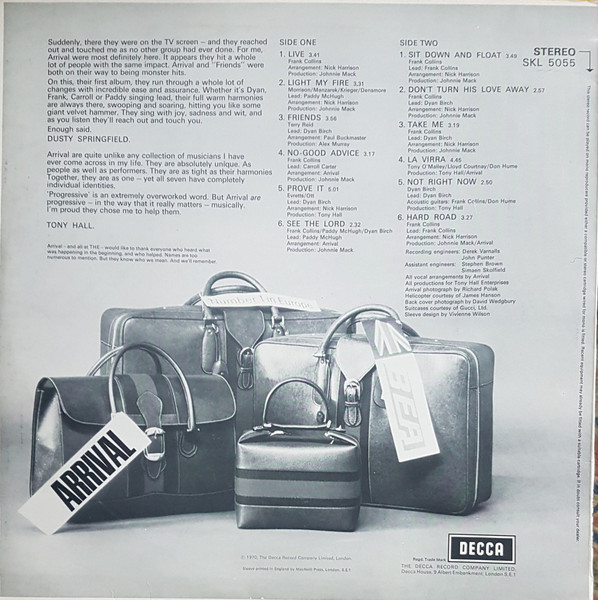
UK band Arrival in 2 albums, 1970 and 1972


On discogs:

A London-based close-harmony pop-rock band featuring singers originally from Liverpool. Following its appearance on Maynard Ferguson's 1970 UK television special and two chart hits, "Friends" and "I Will Survive", the band was booked to appear at the Isle of Wight Festival 1970.

Members: Dyan Birch, Frank Collins, Lloyd Courtenay, Paddie McHugh, Tony O'Malley

As usual in these situations it's difficult to find the information in the database for compositional credits, etc.  I find it also a little annoying, though it's OK overall, that both albums were ST. 

Overall the music is all vocal with as mentioned wonderful harmony vocals in four part chords, nicely done, with the tracks some of which are cover versions (Light my Fire?? Really?) but the original ones are really beautiful and grew on me over the last few weeks.  They sound a little like a mix of Carly Simon and Laura Nyro in terms of the gospel and piano-based influences.

From the 1970 first, Sit down and Float starts with an A minor bluesy riff and melody similar to Carole King's It's Too Late, but moves surprisingly for the chorus into A major with well developed harmony vocals supplemented by oboe patterns in the background, a transition that caught my attention due to its oddness though quite pleasant to hear:


The second album which was released 2 years later is definitely superior.  Of course, bear in mind that I'm referring here to inventive creativity and oddness, progressivity, so if you like simple songs, you'd for sure prefer the first one.  They really try hard to craft original music on this one, with at least half the album containing quite surprising ideas.  Consider So it is written, with its lovely string intro and the gospel sound to it:


Listening carefully to the lyrics, it seems to be a born-again Christian theme.  The buildup to the final verse is just beautifully done, as well as the 'solo' instrumental passage in the middle with string quartet performing over the basic chords.

I was curious to know what are the songwriting credits but it's hard to locate as mentioned earlier. Luckily on the compilation called "All the Songs" everything is nicely indicated, here.  There are also bonus tracks on there, though these are for the most part (as usual) disappointing.  (Well I shouldn't say as usual, the Batdorf Rodney bonuses were amazing.)  I see both samples above were written by one Frank Collins, who was also in the later band Kokomo.    (Note that the other complete cd, called Friends, has an additional BBC session on it. I suggest you purchase that one...)

I can't resist sampling another of Frank Collins' wonderful compositions, Weary Sad:


At times this second album sounds very much like that other beautifully gentle ssw masterpiece, The Street and The Sea which after so many years seems never to be reissued (see here)... or perhaps my old perennial favourite, Melisma.

Credit to him for the beauty of this music...
Geniuses abound...