Showing posts with label Uschi Brüning. Show all posts

Saturday, 7 June 2014

Klaus Lenz Big Band With Uschi Brüning And Klaus Nowodworsky from 1974


Yes sure let's pull out our trumpet when we're at the beach on a summer's day and play some jazz-- why not?

How can we go wrong with this lineup?  Of course I was searching through that Uschi Brüning discography again for some more magic or chemistry like what happened with Günther Fischer back in 1973.  Here on a Polish release she sings on tracks A1 and A3 with Klaus Lenz who made some really gorgeous big band / fusion records in the seventies, along the lines of Noctett, Wolfgang Dauner's United Jazz + Rock Ensemble, all of whose records are worth hearing (and I think are easily available nowadays, having been mostly rereleased to CD) and so many other high-powered fusion or progressive big band artists back then.

In overall flavour this leans more towards the big band sound rather than fusion and rock, but the compositions are as progressive and far from the 'swinging American jazz' I hate so much as you can get, full of the education of modern European music.

A bit of translated bio of Klaus, courtesy Wikipedia, and Google Translate (I love that reference to Nestor!)

"Klaus Lenz (* March 22 1940 in Berlin ) is a German jazz musician , bandleader and composer, especially in the styles modern jazz . He lived until 1977 in the GDR and is considered Nestor the GDR jazz scene. [1] Many well-known artists such as Manfred Krug , Günther Fischer , Reinhard Lakomy , Henning Protzmann ( carat ), Günter Baby Sommer and Ulrich Gumpert learned with him the musical craft and played with him a successful albums. Klaus Lenz played with constantly changing line-ups, a testimony to his constant search for new forms of musical expression. With every formation he reached a high standard. In addition to his commitment as a jazz musician, he composed in the pop field, he arranged for renowned orchestra and wrote film and theater music, among other things, for the DEFA films wedding night in the rain (1967), Käuzchenkuhle (1968), With me not, madam! ( 1969), Sleeping Beauty (1970), Hey, You! (1970) and Stülpner Legend (1972/1973)."

How interesting it is to me that cognitive and computer scientists feel we are very close to approaching artificial intelligence, given that the above translation is so hilarious.  Of course, this statement has been issued as a prediction for many decades now and it will continue on for many decades before a realistic appraisal of human intelligence comes about.  A very interesting new approach involves 'mapping neurons' which, surprisingly, is almost completely possible in the case of for example the mouse brain, though likely to take several years.  It will be interesting to see if such a map of connections will bring us closer to understanding the brain or simply create more confusion because of the missing information, for example, regarding synaptic neurotransmitters and how they communicate, the hormonal signals, or some physiology inside the neurons that changes during thinking.  But I do know this, no one will be able to ever explain to me why I love music so deeply and passionately and how that works in my brain, why it takes me straight to heaven when I hear something as beautiful as the opening to B1 "Permutation" with its shockingly angular riff:

Wednesday, 28 May 2014

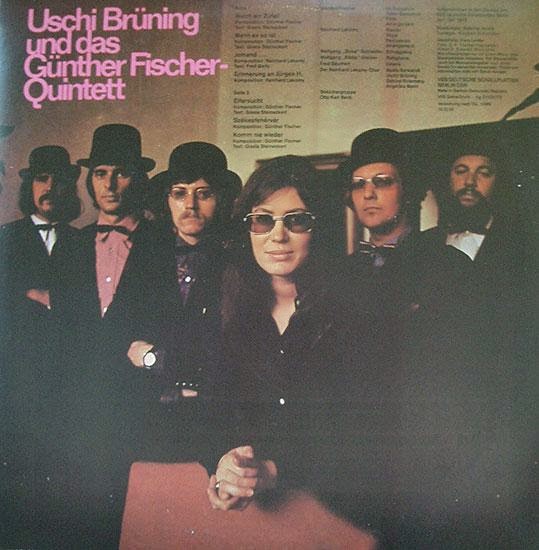
Uschi Brüning Und Das Günther Fischer-Quintett, 1973 [strongly recommended]


Obviously, after hearing the glorious latter half of the above amalgam as it appeared on the utterly unforgettable vinyl "Kombination", I checked through the discography to see what else might be interesting.  The albums credited to Manfred Krug + Günther Fischer-Quintett looked terrifying to me, in fact, I never got past the first track on "No. 3" which is the abominable "Que Sera Sera" -- a song so damnable, that, it is said, the US military has begun using it in their patented torture protocols for suspected terrorists along with those bizarre black hoods, and naked women, and in fact, in their newest weapon, the long range sonic gun which apparently can 'shoot' music at high volumes (on the order of 150 decibels) in a very narrow beam directly at, for example, Somalian pirates interrupting important Walmart shipments of tupperware to Dallas, or innocent senior citizens protesting against the Government reading each and every email and sexually explicit text message they write, such songs (like "Sign, Sign, Everywhere a Sign" which is my personal most-hated song) are employed for good effect.  In the meantime my own patented long-range sonic acoustic gun, which I call 'my two boys,' has still not yet been developed and deployed by the great ol' US Army... which I hope never happens, of course...  There is a (Hungarian?) folk song entirely composed by Gunther Fischer in the middle of side b that is instrumental, improvised in fact, of which perhaps the first 15 seconds are interesting, after that it begins to drag as we get to the fourth and fifth minutes, some perhaps will be tempted to fast-forward, others, to use it in their nice new US sonic guns (which will soon I am sure be legalized like all other guns there, perhaps even mandatory) directed at a nearby squirrel in one's backyard; the great US gov't itself could use it in a later campaign against the Iranians guilty of the unforgivable sin of modernizing themselves past the nineteen-forties when the atomic age is said to have begun at least for western powers (plus Israel), and if that war starts, which I hope it won't, as usual it won't be the leaders who will suffer but instead tens of thousands of repressed citizens will be sacrificed for a regime they had neither stake nor faith in...  luckily, there will be very few US casualties, we can be fairly confident.

Anyways, back to this release, which is formidably good, fresh, tasty, full of inventive songwriting, as you'd expect from this period in time when culturally everything was fermenting, like the genital tract of a very popular and reckless prostitute...  I am not too enamoured of the voice of Uschi, never mind that the name always reminds me of the immortal swedish softcore porn star Uschi Digard (or rather:  here) who was omnipresent in European movies of the seventies, including several of the great Russ Meyer's; here of course she (I mean the singer) bears the most unfortunate resemblance to Janis Joplin, not quite of the same level of interest for most of us men.


First of all consider the first track, "Welch ein Zufall" (i.e. what a coincidence).  I was quite blown away here by the chord progression Gunther wrote, it starts in a nice bouncy typical sixties G minor to A minor repetition, but subsequently I almost fell out of my chair when the verse transitions into  A♭ major, which then drops down to E minor.  Surely a completely verboten sequence!  Then, picking up the E minor, we get a relatively standard upgoing series from E minor, F♯ minor, G, A7, ending up at a tonic of B minor prosaically going to E7.  Without more ado after the chorus the verse starts up again with the G minor / A minor.  Pretty cool, right?  Esp. the anomalous A♭ to E minor.  We can understand how it works if you interpret the A♭ as an F minor going down to E minor.  Brilliantly unexpected though.


Then the album closes out with a really beautiful ballad written again by Gunther and orchestrated with a nice topping of delicatesse.  I wonder how important it might be track down the rest of his compositions on the strength of this last track, he was clearly quite skilled with almost pure Burt Bacharach aptitude at crafting popular-sounding songs with just a nice edge of originality, unusual chord changes, and utter interest especially when compared to the standard pop song progressions like 1, 2 minor, 5th.  This particular entry has a couple of unusual changes in it too including the verse dropping to the 7flat chord, that is, verse starts in G and ends not in D7 or G, but in F, which was a hallmark of early AM radio, e.g. Jimmy Webb's "By the Time I get to Phoenix".  As I understand it, in this song she is telling him not to come back again, because they were friends, just friends, and she thought that was enough. Believe me, she says, if it wasn't so, she would be saying other words to him.  Wonderful stuff.  What a romantic sound and song.

Here it is:


One last note, obviously this recording was made in East Germany, behind the Berlin Wall...  I'll save the commentary about communism, the greatest crime perpetrated against humanity, by humanity, for a later post, or more accurately, many previous ones on prognotfrog.

Fantastic album.  Great find.  And all thanks go to me, this time-- not my friends! lol