Showing posts with label Various Artists. Show all posts

Saturday, 20 November 2021

Germany's Rock Sensation Vol. 1, Various Artists


Three wonderful tracks make this otherwise relatively pedestrian compilation of local artists worth hearing.  They are all by a band called Fate led by composer Matthias Kaul, consider the classic RIO sound of Track b1, called Justice/Musik zur Arbeit:


It reminds me so much of those other RIOs I've posted before, like Random's Nuthin Tricky or Care of the Cow.  Never mind those endless ReR collections.  I wish there was more music like this out there!


Thursday, 18 April 2019

VA's Jazz&Rock from Sweden 1979 and the unknown Stetson Cody Group


Masterpiece too? Sure, at least for the space of a few songs.  One that came completely out of left field for me, and then, curiously enough, proceeded to hit one right out of the ballpark, perhaps by ricocheting off the umpire's noggin.  And then landing in the lap of a baby in the topmost stands.  Don't know if that's even possible, but I could say the same about some of the music on this LP.  Here's the database information.

The Stetson Cody Group's Kraftrock is the singular home run I'm referring to:


Like, wow. Note the tritonal riff opener, played relentlessly, hammered into our entirely willing heads, overtaken by a wonderful solo which leads into a chorus passage or bridge, who knows which it is, with even more dissonance underlying some odd chord changes.  The brilliant guitarist then quotes the standard electric guitar pentatonic blues scale cliches in the most bizarre overlay creating both a point of reference in our memory but drawing it into a bizarre world of its own, as if some mutant birds flew in a normal sky.

The Stetson Cody Group was led by either Swedish guitarist Kjell Lovbom or Swedish guitarist Kee Marcello, or on the single, Rzell Dafbam, all of whom seem to have reverted back to pop after the 1970s ended.  What a tragedy!  There was not to be a full-length studio album.

Note that here on youtube someone posted that same track in a high-energy live performance.  I'm amazed at how much it foreshadows the most creative and best punk / proto-alternative that was to come a decade later, as in the earliest Nirvana, Bleach and Insecticide.  Sometimes these musicians are so so far ahead of their time.

The second track, Kulturnyckel, is also fantastic, less so:


Subsequently I rooted around a little deeper to see what else there is to hear from these Swedish masters, and found a sole single from 1979 which I bought and ripped too.  It's more traditional hard rock and commercial-oriented though it does have some interesting moments too.  The side a will give you some sense:


Sunday, 7 April 2019

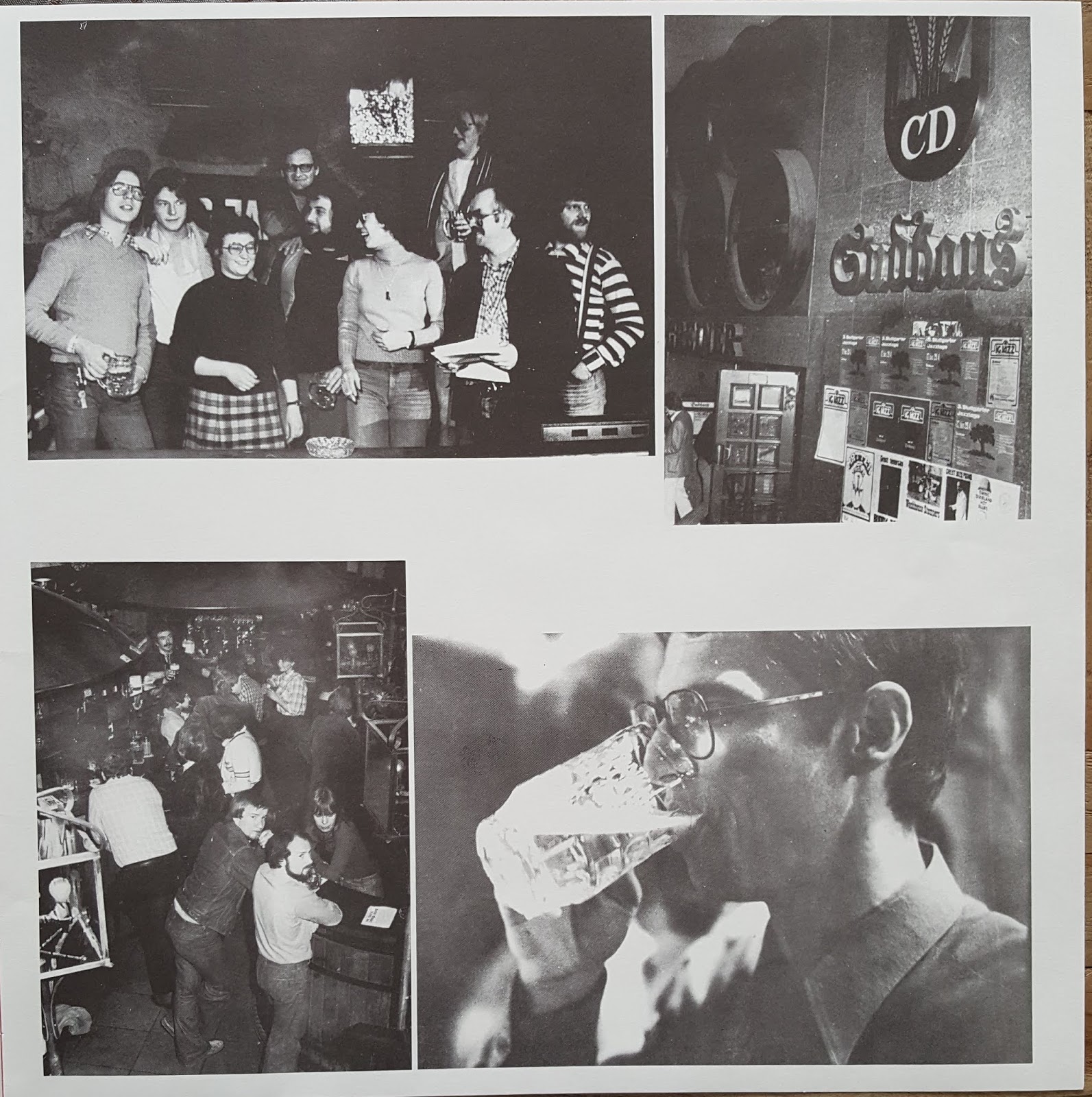
Various ‎Artists - Live Im Sudhaus Stuttgart (3xLP Box Set, 1978) and Li Garattoni in Find out what I'm dreaming


This kind of big thick heavy box set of LPs reminds me a lot of early childhood when I would randomly pull out some of my father's opera or classical boxes and listen to the music, mostly unnecessarily mono, on his ancient phonograph, excited to find out what sounds were concealed on the big black discs, like that dog in the ancient RCA photo-ad.  And I think that over the following years I must have spent the majority of my time either listening to music or playing it, in fact, all the way to the present.

Back to today's piece.  There's a lot of content in here to digest, and not all good.  You might want to skip the digestion part of it even.  When I say not all good, I mean there is a tiny bit of worthwhile music, especially if you were to look at the artists, because these do include such luminaries as Fred Rabold, Peter Garattoni, and Syncrisis.

In the beginning there is dixieland jazz.  In other words, darkness on the edge of the deep.  Chaos on the face of nothingness.  And hell on snowball earth.  All mixed together in one infernal musical concoction.  Now I'm more than a little flummoxed that of all the things to copy from Stateside, these German artists would think dixieland jazz is a worthwhile endeavour.   It's kind of like copying a ghetto crack cocaine habit or, today, crystal methamphetamine for white trash lowlifes living in their monster trucks with a six-packs o' buck-a-beers and shotguns on the passenger seat-- oops sorry to insult y'all-- semi-automatic assault rifles.  And has a fantastic reputation, too.  Don't forget it was the favored music of Woody, who married his step-daughter, Soon-Ye get charged...  Just as surprising to me is the number of dixieland bands in Germany, one would of course only have expected one or 2, at the most, in the same way one would have expected only one or two record mass shootings or serial killers, or middle-aged men sustaining for years a dungeon full of female sex slaves in their basements chained to the ceilings, or men who invited a willing date to come over to be cannibalized.  In short, I really don't recommend you listen to the first LP.

Nor do I recommend you listen to the second one, which is more traditional American jazz circa 1940s to 1950s.  Apparently it took Germany a long time to catch up, given this was released in the late 1970s.  It's very much like the summertime jazz festival they have in my city which is mostly attended by great-grandfathers and great-grandmothers mobilized either via scooters or walkers who despite decubitus ulcers try to get up and dance to the Ellington swing music and, as I watch with a combination of sheer disgust and amused horror, start singing out of tune as I quickly look around for the defibrillators or EMS personnel standing by.  I'll never forget one time when one white-haired lady who probably had osteoporosis knocked over the beer I had in the usual small plastic cup with the horn on her scooter straight into my lap and as I yelled 'Hey, watch it!' and got up to try to restrain her, the old geriatric cases began to rough me up with their canes, whereupon a denture fell to the ground.  Then my old nemesis appears on side c, I refer to the jazz standard Body and Soul, my nemesis who has caused me untold grief and torture throughout this long dreary life of mine spent looking for beautiful new sounds instead of the old garbage dump of old stinking shit full of the usual circling seagulls, made all the worse here by being performed on solo piano, a bit of an affront to those legendary pianists like Teddy Wilson or Art Tatum (who is I think the one being imitated here, or rather ripped off).

By the time we get to side E1 with Mr. Garattoni it's safe to turn on the volume again.  Unfortunately Peter's track is mostly a percussion solo, not the most praiseworthy tribute to Li I can imagine, unless he was some sort of wifebeater.  Btw I've often mentioned her in these pages, if you've never heard her only album, please have a listen to it, it's one of my favourite records of all time.  How often I've wished she made another one.  I remember one reviewer saying something along the lines of 'this is everything Kate Bush's music should have been' and I think that really describes it well.  As good as Kate was at times, she still dwelt in the art rock / pop rock categorization.  Instead, Li worked more in the progressive rock style, combined with the most surprisingly poetic lyrics, and as a result the music is absolutely breathtaking.

We continue with the famous fusion band Syncrisis, which I always thought was inferior to other similar contemporaneous bands like Chameleon, Virgin's Dream, Train, in our pages we had Katamaran, the royal Nimbus etc., there's so much in that genre from Germany.  Too many, really.  Here the band pulls out the standard flamenco chord progression--another hated bugbear of mine (I think, Cminor, Dflat, Eflat this time)-- and does absolutely nothing with it.  So disappointment all around there.  Including disappointment with me on the part of the band, for being so critical.  Sorry guys.  Then we have Fred Rabold, who is generally pretty hit and miss.  On this outing he doesn't even try to hit, just misses badly, doesn't bother to pick up the bat, misses the ball, losing the game, abandoning the championship actually, screwing up the post-game interview by grabbing the female reporter's buttocks, and crashing his Porsche on the way home to his Swedish wife who was about to kick him out permanently.  Are you ready Freddy.

Not until the very last side, having crossed through 5/6 of the thing, do we get a good track with the one-off band Baobab's "no number:"


Seems appropriate then that there follows some more ho-hum music to close it out with a whimper.
As I said, it's a lot of music to indigest today.


I'll post the Li G. album here below, so you don't have to go looking for it.  Everyone should be familiar with this one.  Note that the music (so far as I understand) was written by Ulli Buhl, who also played in the Fred Rabold Crew (before his wife kicked him out, for having sex with Li presumably) and was in a band called Matter of Taste which made a great album in 1979, genre, light but well-written fusion mixed with pop, which I recommend too.

And now it's time to shut up before I get sued, once again.


Monday, 11 June 2018

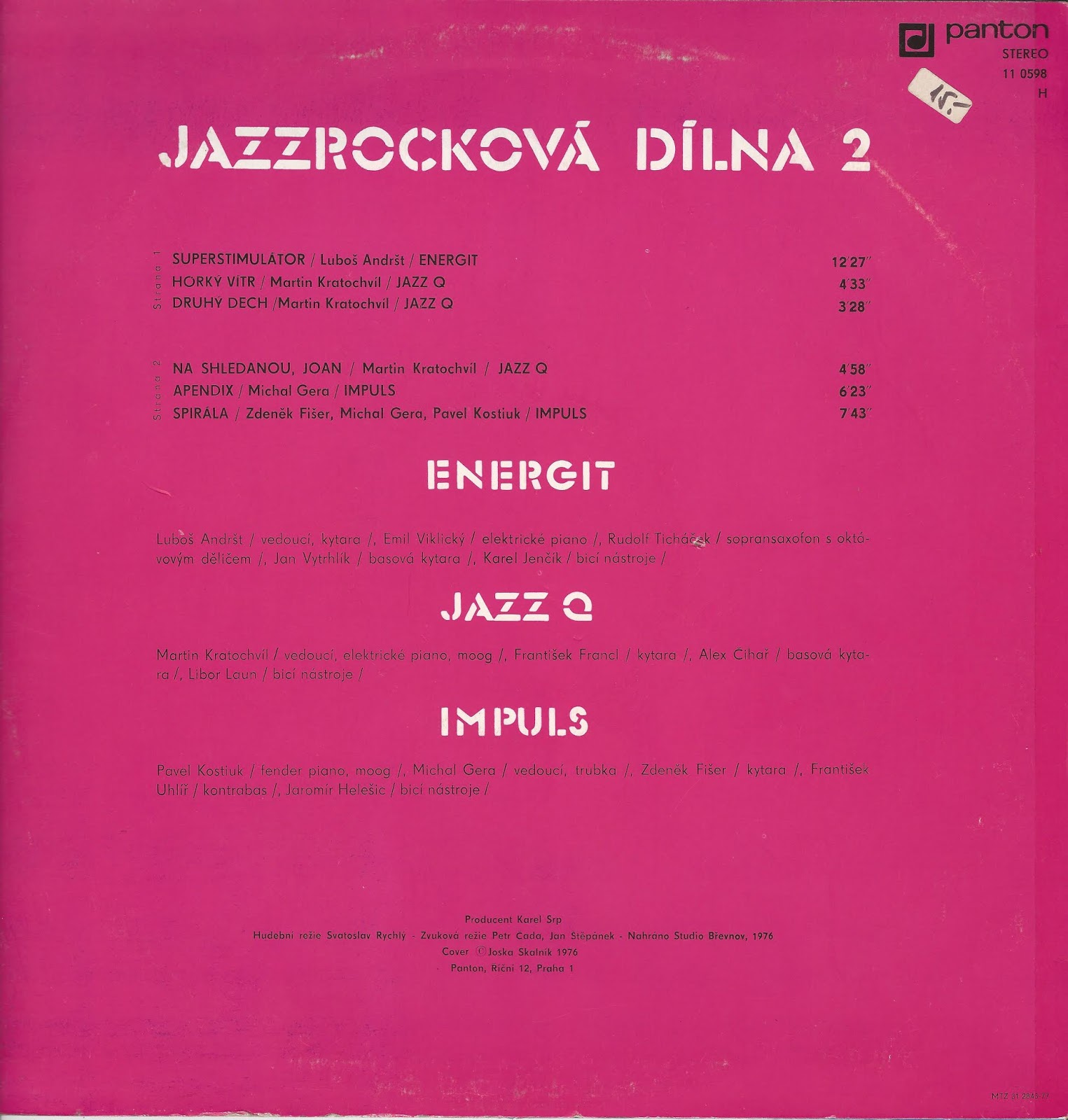
Famous Czech fusioneers Jazz Q, Impuls and Energit in the Jazzrockova Dilnas from 1975 and 1977


In relation to the Mini Jazz Klub series (more to come on that subject later) I noticed these other Panton LPs with the famous bands Jazz Q, Energit and Impuls (plus another band called CHASA with a very disappointing ethnic entry, who apparently never had an LP release).  I think you have already all the albums of those 3 biggies.  (In relation to the middle band, the Lubos Andrst album Capricornus is one of my all-time favourite fusion albums too featuring as it does that supernatural European fusion mix of chamber music and intelligent composition.)  And Martin Kratochvil with that amazing April Orchestra posted years ago here played in Jazz Q, just to remind you.

As far as I know none of these tracks appeared on the released LPs from the seventies which the bands put out.  Some, perhaps all, did show up later on the recent CD reissues.

From the first album it's Impuls' Sly mastery of hard fusion that just knocks me flat-out:


Now turning our attention to the possibly superior second album the most noteworthy entry is the Jazz Q track oddly entitled Na Shledanou, Joan: 


Martin really had a gift for combining (early "mashup"?) blues or jazz-based patterns with his classical education in music, as in this piece.


Wednesday, 15 November 2017

Fourmenonly (Herbert Joos), Michael Gibbs, Jim Hall, Volker Kriegel in the 1973 NDR Jazzworkshop


The number of luminaries here is quite astonishing as can be said by the tags next door to the right, but plus that, all of the following appear: Michael Naura, John Taylor, Peter Giger, Eberhard Weber, Stan Sulzmann, Kenny Wheeler, Norma Winstone, et al.  Think of how many of these artists, perhaps all of them, have appeared in some album or another featured on this blog!!

Herbert Joos and Fourmenonly have a track written by the former called Count Down. It's a free jazz piece and will appeal to those who have a taste for that inchoate genre.  Certainly the Daybreak album from his was a huge fan favourite here on this blog.

Michael Gibbs is one artist not previously mentioned whose work I've loved dearly due to its highly well written nature, particularly in Chrome Waterfall Orchestra and In the Public Interest.  Or let's not forget the formidable work Just Ahead from 1972's Mike Gibbs Band, an album I've listened to all my life and keep on discovering more beauty in.  (Unfortunately the other mid-70s album which was a homage to Shakespeare called Will's Power was quite disappointing for me).  (I can post all the Mike Gibbs albums if there's interest.)  He presents us here with three pieces, the first of which is the gorgeous Mother of the Dead Man by Carla Bley, which appeared earlier in the aforementioned live Just Ahead.  The other two are his own compositions called Just A Head [sic] and Fanfare, which first appeared in Tanglewood 63, not a bad album, though not comparable to the previously mentioned 70s masterpieces.

As usual, there is a throwaway jazz number which is the Jim Hall Group's Body and Soul interpretation, and equally as usual, I have to write the same comments about the sheer excruciating boringness of ordinary jazz standards, the nightmare of having to hear them millions of times in one's lifetime, like Paul McCartney's grotesque Yesterday, etc., etc.

Then this nice big thanksgiving dinner closes out with the beautiful Volker Kriegel group and a composition by Eberhard Weber called Electric Blue-- not quite as strong a dessert as one would have liked unfortunately, since it turns into a very mushy free-for-all improvisation after about the two minute mark-- making the proportion of written material to wanker material about 1 to 100.  And it's 18 minutes and 40 seconds long!!


FULL CREDITS AND SAMPLE:

A1 Fourmenonly - Count Down [Comp. by Herbert Joos]

Bass Clarinet, Flute – Wilfried Eichhorn
Drums, Flute – Rudi Theilmann
Engineer – Hans-Heinrich Breitkreuz
Piano, Flute – Helmut Zimmer

A2 Michael Gibbs Orchestra - Mother Of The Dead Man [by Carla Bley]


A3 Michael Gibbs Orchestra - Just A Head [by Mike Gibbs]

A4 Michael Gibbs Orchestra - Fanfare [by Mike Gibbs]

A2 to A4 Credits
Bass Guitar – Roy Babbington (tracks: A2 to A4)
Bass Trombone – Geoff Perkins (tracks: A2 to A4)
Concert Grand Piano – Dave MacRae (tracks: A2 to A4)
Conductor – Michael Gibbs (tracks: A2 to A4)
Drums – John Marshall (tracks: A2 to A4)
Engineer – Werner Münchmeyer (tracks: A2 to A4)
Piano, Organ – John Taylor (2) (tracks: A2 to A4)
Producer – Michael Naura
Production Manager – Karl-Heinz Schlüter
Saxophone, Flute – Brian Smith (tracks: A2 to A4), Ray Warleigh (tracks: A2 to A4), Stan Sulzmann (tracks: A2 to A4)
Trombone – Chris Pyne (tracks: A2 to A4)
Trumpet, Flugelhorn – Henry Lowther (tracks: A2 to A4), Kenny Wheeler (tracks: A2 to A4)
Vibraphone, Percussion – Frank Ricotti (tracks: A2 to A4)
Vocals – Norma Winstone (tracks: A2 to A4)


B1 Jim Hall Workshop Group - Body And Soul [comp. by who cares?]
Bass – Red Mitchell
Drums – Daniel Humair
Engineer – Günter Simon
Guitar – Jim Hall

B2 Volker Kriegel Workshop Group - Electric Blue [comp. by Eberhard Weber]
Cello – Peter Warren
Bass – Eberhard Weber
Drums – Joe Nay
Engineer – Hans-Heinrich Breitkreuz
Guitar – Volker Kriegel
Percussion – Peter Giger
Piano – John Taylor (2)
Saxophone, Piccolo Flute – Stan Sulzmann
Violin – Zbigniew Seifert


Monday, 18 September 2017

More MPS variation in 1978


More from this variety act, with some more disappointing jazz numbers this time on side 2, the usual organ music on side one and a nice piece by Rachmaninoff, a sonata for piano and cello, which for me was the highlight.

The full-on contents


A1 Kurt Rapf: Großer Gott, Wir Loben Dich, Nr. 10 Aus "Kleine Choralvorspiele Nach Den Gebräuchlichsten Choralen, Op. 135a
Composed By – Max Reger
Organ – Kurt Rapf

A2 Kurt Rapf: Introduktion Und Fuge, 3. Satz Aus "2. Sonate D-moll, Op. 60"
Composed By – Max Reger
Organ – Kurt Rapf

A3 Ludwig Hoelscher, Kurt Rapf: Andante, 3. Satz Aus "Sonate Pour Piano Et Violoncelle, Op. 19"
Cello – Ludwig Hoelscher
Composed By – Sergej Rachmaninoff

Suite Für Flöte Und Orchester:

A4.1 –Symphonie-Orchester Kurt Graunke*, Franz Grothe 1. Satz
Composed By, Conductor – Franz Grothe
Orchestra – Symphonie-Orchester Kurt Graunke*
A4.2 –Symphonie-Orchester Kurt Graunke*, Franz Grothe 2. Satz
Composed By, Conductor – Franz Grothe
Orchestra – Symphonie-Orchester Kurt Graunke*
A4.3 –Das Große Orchester Willi Stech*, Willi Stech 3. Satz
Composed By – Franz Grothe
Conductor – Willi Stech
Orchestra – Das Große Orchester Willi Stech*

B1 Supersax: Oop Bop Sh'Bam
Written-By – Parker*, Gillespie*

B2 Milt Buckner: Locked Hands For Hans
Bass – J.A. Rettenbacher
Written-By, Drums – Kenny Clare
Written-By, Piano – Milt Buckner

B3 Alphonse Mouzon: Master Funk
Electric Bass – Welton Gite
Keyboards – Stu Goldberg
Soprano Saxophone, Alto Saxophone – Gary Bartz
Written-By, Drums, Percussion, Vocals, Keyboards – Alphonse Mouzon

B4 The Singers Unlimited And The Roger Kellaway Cello Quartet: Honeysuckle Rose
Written-By – Razaf*, Waller*

B5 Art Van Damme Quintet: Misty
Written-By – Garner

B6 George Shearing: The Party Is Over
Bass – Niels-Henning Ørsted Pedersen
Guitar – Louis Stewart
Piano – George Shearing
Written-By – Green/Comden*, Styne

Too bad about Roger Kellaway's contribution here, he was a masterful genius, serene and deeply philosophical, on the two albums Cello Quartet (1971) and Come to the Meadow (1974).  Then when I bought and ripped the 1972 album Center of the Circle I was shocked at how irredeemably bad it was and gave up on him.  Of course, as we know, it's the pressure of commercial success that causes these artistic lapses, it's not in any way his fault, nor is he to blame at all previously for writing music especially in the first mentioned album of a delicacy and beauty that is impossible to appreciate for most of humanity...
This MPS comp did remind me though of (drummer) Alphonse Mouzon, of course another fusion star of the seventies worth exploring fully.


Monday, 4 September 2017

Andrew Cyrille, Dom Um Romao, Pandit Prakash Maharaj, Connie Bauer, Lennart Åberg, Bernd Konrad, Luis Di Matteo, Vikash Maharaj, Tom van der Gel, Rudy Smith, David Friesen ‎in To Hear The World In A Grain Of Sand (World Music - Live At The Donaueschingen Festival)


Several familiar names in here obviously, this consists of 4 long tracks, all by different composers, that are not overly boring.  In general I stay away from any description using the words world music but at this earlier stage (1986) the simplistic ethnic component is thankfully minimal, and in fact, the level of composition seems quite advanced.   Title track is by Bernd Konrad, German sax player.

And Happy Laborious Day to everyone out there...


Sunday, 27 August 2017

The MPS Variation series: 1977, 1979 and 1981


In 1977, the first side is entirely classical music, and boring material at that, while the second is jazz and at times makes you miss side one, which is quite an achievement.

However, A2's amazing Mangelsdorff with Kuhn is a great matchup:


There is an always unfortunate tendency for Joachim to unleash his inner Niagara Falls on those poor ivories, which is a bit dried up here.  At least he is willing to dialogue with Albert, and, very much unlike my wife, not drown him out with protestations, generalizations, and a significantly louder voice in pure decibel measurement.  Anyways here's the full information for this record.


My favourite piece from the 1981 edition is a really advanced but delightful easy listening orchestral composition that I could listen to all day in the elevator:


Which is the sole reason I wanted to look further into this series or rather franchise.  And such it will remain, for now.


Saturday, 10 June 2017

NDR Jazzworkshop 1977 with Philip Catherine


The first side of this 1977 release is given over to Buddy Rich and his Big Band, and I won't get into that.  The importance of this edition is of course the presence of the second side's Philip Catherine, the great Belgian guitarist whose works are mandatory for the fusion fan.  His two entries here are India and Les Sept Boules de Cristal, a track which appeared in the stunning, gorgeous opus 1979 Sleep My Love, one of my all-time favourite Euro-fusion records, maintaining a balance of meditative and ethereal beauty from beginning to the closing: an interpretation of an Arnold Schoenberg melody, which completely knocked me out when I first heard it.  Those were the days, right...  The other track from him, India, I haven't located yet where it's from originally though I'm sure it's somewhere, not that I have any desire to hear the original album version as it's one of those drony Eastern songs that remains stuck in one chord (and it's E I think to boot, the easiest of all on the guitar).  The album closes out with the United Jazz etc. (also mandatory listening for fusionauts) and our old hero Wolfgang Dauner playing the unfortunately chosen Bebop Rock (a Dauner composition).  But what a lineup-- with Eberhard Weber on bass, Albert Mangelsdorff, Ian Carr (Nucleus!), Volker Kriegel, and Charlie again on sax, you have a real European all-star band to close it out.

Here's Philip:


Who could ever forget the image of Tournesol surrounded by ball lightning?  I enjoyed rereading all the Tintins last summer with my sons, who became so briefly obsessed with his adventures we were forced to get every book in the series including the awful first one from Russia which I never finished and the incomplete last one which can be found online.  From the perspective of adulthood, we can see there is still nothing to compare with these adventures in terms of how thrilling they can be for a boy, with the perfect combination of exotic locales, courage, faithfulness to his friends and dog, and a lot of slapstick humour thrown in.


Wednesday, 10 May 2017

By Request: the 1976 NDR Jazzworkshop with Dauner and Ponty


These records are not cheap as they are understandably rare, but looked quite interesting.  A few were posted previously (thanks for that!) on the inconstant sol blog (mostly free jazz or improvised) as can be seen here.

A bit of background can be found on wikipedia, translated from the original German:

The NDR Jazzworkshop was first organized in 1958, in which jazz musicians from different bands and different scenes worked together and presented their work results in the concert after several days of trial. The NDR radio station of the same name later remained for the documentation of recorded jazz concerts.

Unfortunately there is no complete discography to be found there, or even in the database here.
But as mentioned in the wikipedia page, some luminaries like (obviously, from the cuneiform release) Soft Machine, Volker Kriegel, and of course Wolfgang Dauner in this installment have appeared in different years.

In fact the presence of the latter composer, to whom an entire first side is dedicated, is obviously the reason this record was of interest.  So what can we say about Dauner's composition which begins with a bloodcurdling scream?  Well, suffice it to say I will never play it in front of my kids and my wife, and I think that says it all.

Sadly, Ponty's track is a bit disappointing with its simple three-chord change:


While the remainder of the tracks, with Eje Thelin's improvised wailing and Al Jarreau babbling in the old jazz manner, are best left unmentioned.


Wednesday, 29 March 2017

Jazzový Orchestr Československého Rozhlasu Řídí Kamil Hála ‎in 1981's Jubileum [with lossless]


Information here. 

More from the former-Czech JOCR posted before. 

Best track, B2's Rosy (unlike Russia's future) Kapka:


Composed by Kamil Hála.


Friday, 13 January 2017

Lubb Dupp - Psychotronic Metamorphosis II, 1982


The title is quite familiar to anyone with a medical background being the auditory transliteration in the old bygone days of the (normal) sounds the heart valves make when they open and close, called S1 and S2 more scientifically.  Anyways, doctor knows best, great title-- archaically elegant, and the artwork is quite interesting as well, perhaps typical of the DIY / homemade crafts style of the early 80s LP covers we were made so familiar with in the frequenting record stores era.

Unlike the preceding instalment all the bands here are quite unknown-- luckily or suitably I should say, since most of the music here is quite experimental, approaching concrete-ness in its auditory impossibility.

The second track, by one Glass Philosophy is quite listenable however:


But as a whole this is nothing like the prior instalment.

Here's some useful information (haha):

A1 – 犬狼都市 - 天地核
A2 – Glass Philosophy - ギャンブル
A3 – 腐乱死体 - 腐乱死体
A4 – D:R:Y: Project - レクイエム・フォア…
B1 – サラマンドラ館 - たこの吸出し
B2 – サラマンドラ館 - 栄養クリーム
B3 – Location - T.V.L
B4 – フリーメイソンズ・ブラックブレイン - なぜならば…
B5 – Anima - Grey City


Monday, 2 January 2017

JOČR + others in Dialogy / Studie (1978) and the related Jazz Ze Studia "A" (1976)


What a beautiful album painting!  Many of these Eastern European artists had such an incredible visual sensibility...

Well here we go again with the iron curtain classicalized fusion.  I certainly never get tired of it and frankly it's shocking how much of it was made back in the day.

Note that the orchestra I've abbreviated as JOCR is described thusly:

Big band of the Czechoslovak Radio, originally established in 1960 in Prague as “Taneční orchestr Československého rozhlasu” (Czechoslovak Radio Dance Orchestra, 1967–1968 also known as Orchestr Karla Krautgartnera and led by Karel Krautgartner until 1968. Having identical personnel as the latter two, this orchestra name was used for jazz recordings and releases from 1962 until the early 1990s, usually conducted by Kamil Hála.

What is of note for the prog historian is that they played in a famous collaboration album with Modry Efekt (THE masters of Czech prog without a doubt): Nova Synteza 2.  That was in 1974.  It might be that these artists especially the pianist / composer Kamil Hala will be a rich vein of new material to mine.  We shall see.

From the earlier 1976 album Jazz Ze Studia A, the track called Fire River gives you an idea of the kind of tasty counterpoint fugal fusion we are dealing with:


Compositions by a variety of artists.

Moving on to the 1978 album, here listed.  Exactly as I was expecting we have a unique blend of jazz with modern classical music played by orchestra.  This time, compositions by Pavel Blatny.

The first track called D-E-F-G-H-A (why the H?) is quite unpromising, being in a deplorable C major, though it does have some nice brass fusion in the mid-section, sounding a bit like a salad university days exercise in composition.  On the other hand, track B2's Dialogue is quite atonal in its mastery:


It's hard to escape the influence of Stravinsky, wherever you might be, in space or in time.  I guess my one minor complaint would be that taken as a whole this is lacking in cohesiveness and seems to diverge abruptly between baroque-style classical and atonal elements, especially in the last track.  Also more than half of the total musical time comprises improvised solos, which is a bit above the median for Eastern European fusion.

I should also mention this other album in conjunction with Michael Kocab (remember him?) and Eva Olmerova, as worth seeking out and hearing.  Note that it was released officially to CD and therefore can't appear here by state rules and the Great Putin's direct orders, on penalty of getting all party emails hacked.  And all hail the Tiger-Bear of Siberia, future ruler of Greater Europa!  May your conquests exceed those of Alexander, Genghis Khan, Napoleon, British Empire, and Kardashians all combined!  And go on to planet(s) of Proxima Centauri, nearest non-sun star!  Hahaha!!  Let us drink toast of vodka to this, from oil barrel!


Saturday, 29 October 2016

Psychotronic Metamorphosis from 1981 Japan


I believe this was first posted in the mutant sounds blog, which I sorely miss.  The amount of unusual but wonderful music those guys shared still astounds me.

Information is to be found here.

Track b2, No More Rainy Day, pretty much a lesson in progressive rock by our old familiar favourites Negasphere (and here) with its gently spun atonal piano intro leading into hard guitar backed by strings:


Subsequently a wonderful Holst-Planets-like drum beat leads to more chunky chords.  Am I psychotronic myself or is it a progressive masterpiece?


Sunday, 16 October 2016

D. Humair, J.-L. Ponty, Phil Woods, Eddy Louiss in 1977's La Sorcellerie A Travers Les Ages [by request]


La Sorcellerie A Travers Les Ages was composed as a Soundtrack to the Movie "Haxan" by Danish filmaker Benjamin Christensen.

First track called Générique (Theme):


The last track, which was missing heretofore, turned out to be quite entertaining and although digressive, interesting enough in its originality to sustain some attention.

Credits:
Clarinet – Michel Portal
Drums, Composed By – Daniel Humair
Organ – Eddy Louiss (tracks: B)
Saxophone – Phil Woods
Vibraphone – Eddy Louiss (tracks: B)
Violin – Jean Luc Ponty (tracks: A)


Saturday, 8 October 2016

String Summit's One World in Eight, 1981


When you look at the involvement here of famous jazz or fusion musicians you get the feeling it's like a high school reunion.  From discogs:

Bass – Barre Phillips, Bo Stief
Cello – Abdul Wadud
Drums, Percussion – Fredy Studer, Pierre Favre
Engineer – Franz Wagner, Norbert Kloevekorn*
Flugelhorn – Ack van Rooyen
Guitar – Christian Escoudé, Harry Pepl [note that these two have appeared here before, separately, both more than once]
Piano, Synthesizer – Wolfgang Dauner
Trumpet – Ack van Rooyen
Violin – Didier Lockwood, John Blake, Krzesimir Debski

Bringing in so many luminaries does not though lead to a nonlinear multiplication in quality, as is so often the case, with the opposite effect perhaps in evidence.  Dauner once again as he did with the Family of Percussion pulls out his old Trans Tanz composition.


First crazy track called One World in Three (written by the violinists D. Lockwood, Blake and Debski):


Monday, 25 July 2016

VA Kleeblatt 24 - Jazz Rock (GDR 1988)


More light fusion from the GDR, perhaps less interesting to us in general.  The bands include Flair, Fill In, the awfully named Bossa Nostra, Gin-Chilla.  The final three didn't appear elsewhere, to no one's surprise.  The first track, by Flair: