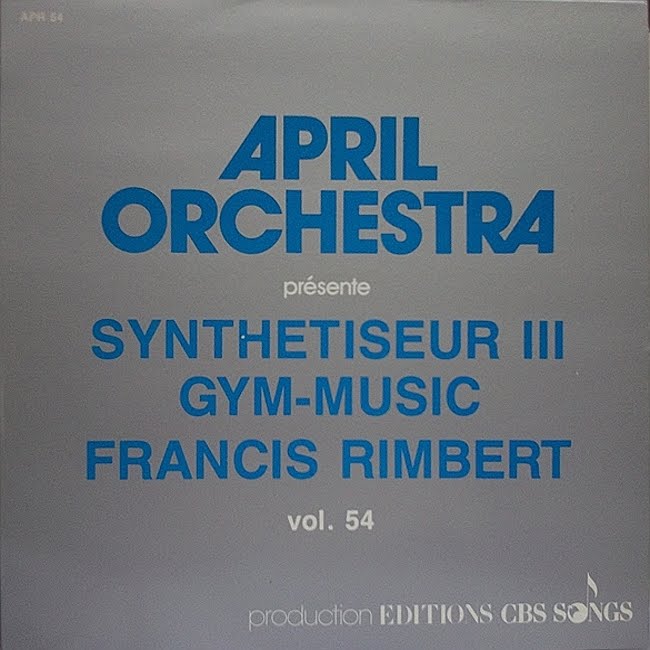
Showing posts with label April Orchestra. Show all posts

Monday, 29 June 2026

April Orchestra 48: Francis Rimbert + Frederick Rousseau


The music here is almost as good as the old classic AO's I collected way back when, see search function here.  This one I skipped over at the time.  And what a surprise to be back here with these guys and their seemingly endless library tracks.  Looking over the whole series, it's truly amazing how much great music there was on offer there in that little quiet and neglected local library.

This one came out in 1982, and it seems all the compositions are cowritten by the two artists.


Keyboardist and composer born at the 3rd of October 1953 in Val D'Oise (France). At an age of 5 he started to play piano and later accordion. At the age of 7 he started to play harmonium in the church. He studied at the Paris Conservatory (Paris, France) but didn't like the classical music ambiance. At the age of 14 he started his first band, which he didn't like, so he stopped this band. Later he founded FanChris together with a folk singer/songwriter.
In 1978 he start working at a music shop specialized in synthesizers in Paris where he start rehearsing on those synths. There his career started when his boss offered him to record an album: "Bionic Orchestra" and he quit FanChris. Some later he met Jean-Michel Jarre with who he works often.

And Rousseau, briefly:

French keyboardist and synthesizer player, sound engineer and composer.

Quai de L'enigme:


Marguerite Degarne:


Wednesday, 27 April 2016

Talgorn, Izzanelli, Rimbert, Attard, etc. in April Orchestra Vol. 56: Compilation Jingles [1984] by request [plus lossless]


Like a viral rash you can't get rid of (hopefully not the dreaded Zika) it's back, our AO series...  Each time I ask myself why do I punish myself like this-- (and this was definitely a bitter torture when you consider there were 25 tracks on side b most only 15 seconds long)-- oh yes now I remember, once in a while, like with RCA Volume 15, a track emerges that lights up my life like a rocket and will illuminate it for what feels like a thousand years...

First of all, composing information can be found here.  Note the presence again of Romanelli (here called Izanelli) from Vol. 38 wherein the combo with Jannick Top proved very fruitful.  In fact, the first track, for which he is part responsible, is quite nice, and surely appeared in one of those old French movies with undressed stars lounging by a summer beach cottage talking about philosophy and who to have sex with:


Can you believe the title of that composition is Rocking Chair?  That surely is the worst title selection in the whole of the AO series.

Subsequently, Rimbert's A2 track is a little disappointing.  But another favourite Talgorn (Vol. 57) returns at A3 with the oddly titled, but well-composed Fish Race:


The majority of side B is given over to L. Attard, whom I did not like in his earlier record.  A representative track by him would be the last one, with its gentle harp strumming accompanied by vibes-- it's a true shame he didn't develop these ideas more fully, but at least he abandoned the obnoxiously French accordion:


Wednesday, 6 April 2016

RECOMMENDED!!! Gianni Marchetti and the missing RCA April Orchestra Volume 15


So here it is, the big surprise I was referring to last week, last two weeks...  
and it surely is a beauty!


At last this final one missing from the RCA Series of Ital-AO's can be heard, of course, it's by Gianni Marchetti.  I think I spoke about him at length in the post on his magnificent Solstice album.   Which was truly a lost masterpiece of composition.  Someday I will nail those other two that are contemporaneous, Iris and Gimmick, and perhaps provide everyone with the great pleasure of hearing them too.... I hope!
Anyways,  I'll be honest, this by comparison is definitely a mixed bag, with some standard-clause library tunes like A1's Mexico Border (probably written in a state of anesthesia, or while he was sitting in his underpants), some pretty gratuitous silliness maybe for some slapstick comedy with that balding curly-haired Italian comedian that starred everywhere in the seventies frantically running about while beautiful big-bosomed starlets slept with all kinds of leading men, there's some bona-fide righteous funkiphizing, but then, abruptly, there's some really gorgeous Italian soundtracky Morricone stuff like A3's Over:


Check out how the high F over a 7-octave (!) below bass D creates the Dminor sound on the grand piano, which is later echoed with a high C over the tonic key of F.  The arrangement of the strings is just superb.  Unbelievable mastery of composition here.  (It makes me weep to think of the classical music being played in concert halls all over the world at the expense of stuff like this.)  And to close out, that fantastic high note D plays again at the end, like a bell tolling, because:

"Don't ask for whom the bell tolls,
It tolls for thee..."

[Who wrote that again? was it Milton? or Pope?]

Stay tuned till the end, difficult as it may seem around halfway through the second side (when it sounds like he forgot to get dressed after a bathroom break), because the last track called Equinox is a real stunner showing to me very clearly the influence of Pink Floyd's Dark Side of the Moon with the slide guitar effects and the wordless yelling/singing of the infamous, inimitable, Great Gig in the Sky...  
Yes, that Great Gig in the Sky will be something we'll all hear one day, all of us...

But before that, we have the most utmost beautiful music to leave us with the happiness of miracles.  

Like I've said before, for those like us who love music, this is the closest we will get to heaven in our lifetimes.  

That last track was well worth the price of admission here, without a doubt... you won't believe your ears!

Sunday, 20 March 2016

Missing April Orchestra: Slim Pezin & Patrick Bourgoin in Vol. 62's French Groovin' from 1985


Note that Slim Pezin, the guitarist, was in celebrated French fusion supergroup CCCP, where he penned / picked the fabulous song Death of the Spanish Lion.  On the other hand, there is little information to go on for his colleague in this adventure, Patrick Bourgoin.  So curiosity really drove me to have a listen to this missing AO, adding to the fact it was luckily cheap to purchase. Cheap for a reason?  Well, this is of course fuzak of the worst possible kind...  We can't blame the artist/composer, it was the tenor of the times, the zeitgeist, this simplicity that was in vogue, bullying all over the complicated intellectual patterns of novelty that once obtained in the art of popular music...

Have a listen to the first track:


Wednesday, 2 March 2016

April Orchestra Part VI.ii: From Volume 53 to the bitter end...


There are seventeen left here after Volume 52, from 53 through till the end at 69; however, volumes unavailable thus far include 55, 56, 61, 62, 63, 66 (a percussion album). So I have 11 to present today some of which, or perhaps the majority of which, will be very disappointing.

Quickly, Vol. 53 from Morati is simple electronic and drony music such as doesn't appeal to me at all.  Rimbert's 54 is minimal synth that horrifically reminds me of the concurrent Olivia Newton-John aerobics phase of jumping up and down to ultra-basic beats.  58 is simple classical similar to the 52 I presented earlier, 59 is folk music from S. America again of no interest to me.  60 is the easiest kind of baroque classical with violin-played melodies, oddly annoying.  The series of missing volumes in the sixties from 61-63 could be interesting.  On the other hand volumes 64 and 65 are not even worthy of mention, despite the fact Milpatte reappears on the latter.

Yet I suppose it was a good idea to attempt to complete the series out as there were two mini-gems lurking hidden in this installment: Frederic Talgorn's Volume 57 with its surprisingly zeuhl-influenced progressive compositions, and the 68 Impressions de Voyage from Steve Shehan.  This was his first work released, at least in this database, yet his discography continues on for some time as you can see. The music therein is described as tribal, ambient, minimal or electronic, but here we can still detect the slight influence of more advanced compositions.

First, from Talgorn's 57, here's the oddly perhaps zeuhly titled track Ladnophaxi:


Then from Shehan's 68 consider the first track, called Fever:


Finally, appropriately enough perhaps, the series closes out with some digital keys music from Patrick Vasori that will take you straight back to those horrible casio days with fake drums and loud echoey A minor chords punctuating the choppy melodies.


In the entire series (of 85) the missing ones are twenty: the volumes 10 (Indes), 11 (Classical), 12 (Classical), 14 (baroque easy), 17 (phillie), the Czech classical ones 23, 24, 26, 27, 29, 30, then 33 and 35 which are available already musically on other records, and in this series, 55, 56, 61, 62, 63, and 66.  In the Italian RCA series there is the No. 15.  Given the descriptions, and often, samples posted on youtube, there is little desire on my part to obtain any of those missing.


Friday, 26 February 2016

AO Part VI.i: Volume 52 by Raymond Guiot [1983]


Classical chamber music here, I thought it might possibly be interesting, but overall too simplistic or baroque for my taste, perhaps about 18th century in style, before the Europeans discovered the beauty of chromatic notes and/or a slight spice of dissonance.  Note that the composer, Raymond Guiot, is different from the Dominique Guiot whose 2 utterly gorgeous library albums I uploaded earlier.

The oboes of Les Estaminets En Flandre {i.e. small cafes} are quite plaintive, as usual:


Wednesday, 24 February 2016

April Orchestra Part V: The Italian RCA Series from 1 to 16 [missing 15]


Well I think you get the idea.. really reminds me of my old childhood stamp collection...

Remember these are entirely different from the other April Orchestra volumes 1 through 16, in fact, they are copies of previously available Italian library records.  I don't understand why they had to be repackaged or recycled as AO's.  At any rate it's a real mixed bag with a lot of abstract modern Morricone music in the earlier numbers, none of which I enjoyed, but two albums are real delights, the one stolen from "Romantici," which is the Volume 8, and Volume 13 which returns to fusion, though only for one brief LP:


That was Northern Lights from Volume 13, the first track.  Music is by Puccio Roelens.

From the beautiful album usually known as Romantici, here is Nostalgia Di Un Giorno Felice which was composed by the incredibly prolific OST composer Carlo Rustichelli  and was derived from a 1968 Western called Un minuto per pregare, un istante per morire 


With a very Morricone-like sound, wouldn't you agree?  Hearing this soft ballad I'm tempted to try to find the film, though it was rated quite poorly, possibly explaining why I never saw it before when I went nuts over the spaghetti western genre.


Monday, 22 February 2016

Missing AO Pt. IV.iii: Patrick Vasori's Keyboards Music, Vol. 44 from 1982


A pleasant pink this time...  the graphic artists must have been happy with this series.


Recall that Patrick Vasori was the son of composer/arranger/conductor Claude, who was usually called Caravelli on the AO releases.  It was the young'un who composed my favourite AO track ever, Dany's Love Song, from Vol. 31.

Taking a quick glance at his discography it seems he made mostly AO music, appearing in the volumes 16 (a good one), 40, this 44, and the last one ever which appropriately was no. 69 (to come soon).  After this he made another library record called Tie-Break in 1987.  If anyone has a copy please upload it though as I wouldn't mind completing the collection for Patrick.

On this particular record we have all-electronic music, not influenced yet by the 'minimal synth' style that was soon to destroy any proficiency in composition held over from the seventies, and thus, overall, quite a listenable opus, similar overall to the Teddy Lasry albums from later years.

Consider the track called "Connexion:"


For evidence in favour of his progressive compositional skills consider the track called "Fight" which yet again, is indebted to the great Stravinsky's Rite of Spring polytonality:


It's unfortunate that track couldn't have gone on longer, though, overall, this is quite a long album comparably speaking, and by that I mean of course that it actually hits the 38 minute mark.

So I'll let you explore the rest of the tracks...


Friday, 19 February 2016

Missing April Orchestra Part IV.ii, Volume 41 by Bernard Estardy from 1982 [lossless]


A very short LP (prob. about half an hour) and with a mixed bag of sole-percussion, synthesizer styles, bits of baroque, and light-hearted fusion, the kind most of us can't tolerate much of.  Not too convincing in the direction of attempting to obtain the missing volumes definitively.  The track called "But where did my melody go" is really missing a melody.  That would have been unheard of in the early seventies AO days, when there was still a premium placed on excellence in composition.  Nor is there any irony, but I suppose there is a tongue possible in cheek in a later song called "It's not nothing, but almost" which in a way disappoints our modern ironic sense by being actually listenable (in a love boat) way rather than being really nothing:


Wednesday, 17 February 2016

April Orchestra Part IV.i: Volumes 41 to 51 [41 and 44 to come]


There is no chance I will last past the early fifties in this series as the pain of slogging through so many dozens of tepid albums ever closer to a lukewarm forgetful kind of nothingness, literally more than 500 tracks, is really getting to my sanity.

Quickly:  Volumes 41 and 44 are to come later, they are not included in this package.  Volume 42 with Lucien Attard on the uber-French Accordeon is a bit grating as it lacks in originality.  You will be pleasantly or in my case unfavourably reminded of being back in that country famous for its cheeses, cathedrals, and spectacular rudeness, when you hear this one.  I have little interest in knowing who Attard is after listening to this, nor in returning to his country after my fourth and last visit there.

Volume 43 presents the team of Roland Romanelli and Jannick Top again, we saw them together before to good effect (no. 38).  Note that the former made a chansonnier private press in the seventies and went on to convert, as so many of his countrymen did, to simple upbeat electronic-synthesizer music in the eighties, as well as contempt for everyone non-french/not white.  Thus his album Connecting Flight from the same year is very similar to any output by for ex. Jean-Michel Jarre, Patrick Vian, or even Teddy Lasry.  Didn't like it myself.  (Though not as much as I hated the arrogantly inept staff at Charles De Gaulle airport.  Like so many others with similar experiences, perhaps half the world, I will never go back there.)  On the other hand, this volume has some very pleasant compositions in the usual soundtracking style.  I guess with that team you couldn't go wrong.  Too bad they don't work at the Gare Du Nord, in Paris.

Volume 45 is pleasant as well with at least a handful of listenable compositions, this time from Francis Rimbert and Jean-Pierre Savelli.  The former appeared in multiple AO's as well, most recently in the 36 which again I hated.  Note that he is another exemplar of the synthesizer-addicted Frenchman.  I wonder what it is about fine red wines, electronic keys, and supreme arrogance that fit together so well.

Volume 46 is interesting, called Carmensijazz (the title of one of the compositions), it includes tracks or excerpts from the Traitement Special record I ripped earlier on the second side, the first presenting some mediocre modal jazz, acoustic though not fusionic, from one Christian Pegand.  This gentleman in the same year (1982) made a record called Salut J' Arrive, could be good?  Anybody know?

Vol. 47 was a popular one due to involvement of library luminaries Milpatte (Bernard Fevre) and Serge Bulot.  I believe it was ripped long ago and is prob. well-known to everyone.  Bulot's album Sanctuaire D'ecole to me is one of the best library records-- ever.  This lp is comparatively disappointing.

48 now instead has Francis Rimbert teamed up with Frederick Rousseau.  The latter's career almost started here, and stretched out into the eighties and nineties.  I wonder if his later output was innocuous or interesting?  At any rate, the economic law of diminishing rate of returns applies here and there are only 2-3 interesting compositions in this one.  It would be magnificent if we could chart the no. of good songs versus progression over time of the volumes, as I am relatively certain we'd get a bell curve with its peak at volumes 32-34.  Well, except for the nadir of czech classical music period from 23-30, where there is literally nothing, so I suppose instead of a bell we'd have a punched derby hat, clearly punched for good reasons (a bimodal distribution, perhaps even trimodal depending on how much you like the sound of Philadelphia).
For example, Rimbert's Quai de l'Enigme:


49 and 50 present the team of Romanelli (here called Izzanelli) and Jannick Top (here called Samy Wathson) for some very simple synthetic easy listening.  I wonder what was the reason for all the pseudonyms in library music, for some specific licencing or copyright purposes?  It doesn't make sense as you'd think the reputations of the composers would mean something.  Strangely the first is forgettable while volume 50 is extremely good, another peak to render more multimodal our curve.  The latter's all-out space theme is particularly nostalgic and evocative for me.  The track Patrouille Spaciale (i.e., space patrol) from them is very Stravinskyesque, it reminds me as well of the best of legendary and hugely versatile library composer Alan Hawkshaw (cf. his 1977 Road Forward, another library masterpiece everyone should know):


In Volume 51 Rimbert is now sadly alone and, so deep in the 80s, we can't really expect too much anymore, nor of course do we get it.  I, too, had low expectations going into the Galeries Lafayette and mostly went with my wife to show her the architecture and design.  Little did we know the salespeople in addition to being unhelpful, obviously, that part was not a surprise, would scream at us to clean up after our children, berate us for our baby pulling off his sock and having a bare foot, and prevent us from touching their shoes for sale (and thus from buying any).  Sigh.  Yet let us enjoy the country still from the safety of our record players...


Wednesday, 10 February 2016

April Orchestra Part III: from 10 to 30, with many missing [1975-1979]


After the Volume 10 in which poor Renaissance man Rameau was trotted out for some unfathomable reason, French conductor Caravelli (aka Claude Vasori) was brought in for some really easy listening in Volumes 11 and 12, which are yet unavailable.  A more promising set appears in Volume 13 with some very entertaining compositions by Christian Chevallier (who created with A. Feanch one of my favourite library albums ever in Space Resonances), consider for ex, his Prelude pour un Balladin:


Volume 14 presents "baroque by swingle" and sounds so unappealing I am thankful it makes no appearance here.  Volume 15 steals tracks from the progressively famous Lard Free of Gilbert Altman (extracts from both their 1973 and 1975 albums).  The team of Caravelli and son Patrick Vasori who composed quite a bit in later editions, appear with some great mood music in Volume 16.

And then of course our poorly helmed boat suddenly capsizes for Volumes 17-19 with the sound of Philly.  The ship recovers-- somewhat-- with Volume 20 in which Shylock's two albums, fabulous complex French prog masterpieces, are ripped off, along with cathedral organ compositions by another library alumnus, Michel Magne.  In fact the subsequent Vol. 21 devoted to Magne's orchestral music was already ripped for prognotfrog 4 long years ago now.

An odd turn to Spanish guitar music with Manolo Sanlucar is featured in Vol. 22 before the bottom completely drops out of the franchise, as Volumes 23 to 30 are devoted almost entirely to orchestral modern music from Czechoslovakia-- with the exception of Vol. 28, also posted in pnf long ago, with its amazing fusion from Jiri Stivin's Zodiac masterpiece and Klapka's Mahagon, as well as a big band called Konstelace Josefa Vobruby.  (Everyone should have that first mentioned.)

Now I love good modern classical music as much as any tweed-pantsed food-stained sweatshirt-wearing old man who goes to the local symphony hall purely to drink those tiny free one-ounce 2% milk containers next to the coffee machine, but the music in the volume that is available, namely 25, is not even well-written and was impossible for me to slog through even with pants pulled up above my belly button.  Have a listen, if you dare.  But I beg you not to request those.

So, available currently are the following: 13, 15, 16, 18, 19, 20, 21, 22, 25, and 28.